ALL EYES ON OBAMA

OBAMA WON THE ELECTION - AWESOME. SO NOW ITS MY DUTY TO WATCH THE NEWS ON OBAMA, COLLECT IT AND PASS IT ON TO YOU. WE NEED TO MAKE SURE HE KEEPS HIS WORD AND LIVES UP TO HIS IDEALS AND PROMISES.

Wednesday, July 27, 2011

Religious groups set prayer vigil for U.S. debt deal #p2 #tcot

from http://www.reuters.com/article/2011/07/26/us-usa-debt-prayer-idUSTRE76P07520110726

(Reuters) - Across the street from the U.S. Capitol in the small north lawn of the United Methodist Building, Christians, Muslims and Jews will pray on Tuesday for the country's budget, and hope to teach Republicans and Democrats a lesson in compromise.

So far, nothing else has worked, not even President Barack Obama's cajoling or warnings from Wall Street titans that a failure to promptly raise U.S. borrowing authority would result in economic Armageddon.

As the 435 members of the House of Representatives and 100 senators do battle inside the Capitol, some 100 religious faithful will try a different approach to convert debt limit doubters -- a daily prayer vigil.

But it's not just any budget deal these activists want to settle for in return for raising U.S. borrowing authority.

The vigils will be a way of lobbying against any deal that slashes too much from programs that protect the underprivileged, like nutrition programs for the poor or health care for the poor and disabled.

"I hope that it's not only effective but a model for how Democrats and Republicans, who differ on many issues, can come together on a common issue to move the country forward," said Rabbi David Saperstein, executive director of the Religious Action Center of Reform Judaism.

(Reporting by Lily Kuo; Editing by Cynthia Johnston)

(This story was corrected to change the name of the rabbi quoted in last paragraph)


Posted by MAG at 2:43 PM No comments:

If Tea Party Likes a Debt Deal, It Can't Pass: Economist #p2 #tcot

from http://www.cnbc.com/id/43906649

As the high risk-game of chicken over raising the US debt ceiling draws closer to possible economic collision, one economist is warning that any deal that wins approval from the right-wing Tea Party movement will pass neither the Senate nor the president.

"As the Tea Partiers are showing no indications of being willing to compromise at all, the only way a deal can be done is for moderate House Republicans—those who appreciate that default would be hugely damaging for the country—to side with Democrats to pass a bill that the Senate and the president can sign," Ian Shepherdson, chief US economist at High Frequency Economics said in a research note on Wednesday.

As things stand, such a solution looks very unlikely in the coming days. The latest plan from House Speaker John Boehner needs revising following Congressional Budget Office experts warning it would not deliver on the spending cuts it claimed. That plan is likely to be voted on by Congress on Thursday.

President Barack Obama's Chief of Staff, Bill Daley, told CNBC on Tuesday that he is confident that some kind of plan will pass. The head of global sovereign ratings at S&P has told CNBC that the US could prioritize debt payments to avoid default but warned such action would be "deeply disruptive" to the US economy.

A problem for the Republican Party could be that the majority of Americans now back a debt ceiling [cnbc explains] plan that involves both spending cuts and tax hikes. A Reuters/Ipsos poll this week found that 56 percent of American's favor a plan involving both cuts and tax increases.

"We had hoped by now that House Speaker Boehner would have started to recognize this reality, but press reports suggest that he focused on party solidarity in his conference call with Republican House members," said Shepherdson.

"Perhaps the light bulb will come on when the inevitable pushback from voters becomes overwhelming. We can only hope that happens before August 2," Shepherdson said.

© 2011 CNBC.com
Posted by MAG at 2:42 PM No comments:

U.S. May Have Way to Cover Bills After Deadline, for Week

from http://www.nytimes.com/2011/07/27/us/politics/27date.html?_r=1

WASHINGTON — It turns out the federal government is sitting on some extra cash.

Thanks to an inflow of tax payments and maneuvering by the Treasury Department, the government can probably continue to pay all of its bills for several days after Aug. 2, providing potentially critical breathing room for Congress to raise the debt ceiling, according to estimates by several Wall Street banks and a Washington research organization.

The consensus is that the government will not run short of money until Aug. 10, when it would be unable to cut millions of Social Security checks without borrowing more money.

President Obama has described Aug. 2 as a "hard deadline" for Congress to increase the maximum amount that the government is allowed to borrow.

"We have to do it by next Tuesday, Aug. 2, or else we won't be able to pay all of our bills," Mr. Obama told the nation in his speech on Monday night.

Jay Carney, the White House spokesman, restated that position on Tuesday.

"That's not a guess. That's not a political opinion," Mr. Carney said. "It is the judgment of career analysts at the Treasury Department. We give up our borrowing authority without action by Congress. And the result of that risks default for the United States for the first time in our history."

That description, however, conflates two distinct events.

The government will exhaust its ability to borrow more money on Aug. 2, which is equivalent to maxing out a credit card. But there still will be cash in the federal wallet.

Some Republicans have expressed skepticism about the Aug. 2 deadline, describing it as an artificial line drawn by the Obama administration for political reasons. Analysts emphasize, however, that the deadline is real; it's just the date that is inexact.

"Should policy makers wait till Aug. 10 to come to an agreement? If they can agree sooner, absolutely not. There are no definites in this case," analysts for Barclays Capital wrote in a note to clients entitled "Is August 2 really 'August 2'?"

Analysts also said that all of the estimates, including those from Treasury, were necessarily inexact, because they relied on variables like incoming tax payments. That means each passing day without a deal increases the risk that money will run out.

"This is more like predicting the weather than predicting the sunrise," said Jay Powell of the Bipartisan Policy Center, a nonprofit in Washington that has analyzed the issue.

There are other risks in waiting. The Treasury must continue to repay debts as they come due, then borrow the same amounts anew. Officials are concerned that it will become harder to find investors for United States government securities, and that remaining buyers will demand higher interest rates.

The Treasury plans to auction about $87 billion in short-term securities next Monday and Tuesday. The following week it plans to hold a much larger auction of long-term debt.

All told, the government plans to borrow almost $500 billion in August. If interest rates climb by even a tenth of a percentage point, the annual cost would rise by $500 million.


Posted by MAG at 2:40 PM No comments:

CBO: John Boehner's debt bill comes up short #p2 #tcot

from http://www.politico.com/news/stories/0711/59983.html#ixzz1TIm97wzM

New cost estimates from the Congressional Budget Office could pose a problem for Speaker John Boehner as he tries to rally conservative support for his two-step plan to raise the federal debt ceiling and avert default next week.

The first installment of $900 billion is contingent on enacting 10 year caps on annual appropriations which the leadership had hoped would save well over $1 trillion. But CBO late Tuesday came back with a report showing the legislation would reduce deficits by $850 billion when measured against the agency's most current projections for spending.

At one level, Boehner is the victim of his own success, since that same baseline is $122 billion lower in direct spending because of concessions the speaker won in the April government shutdown fight. But that won't help him much with restless conservatives and this could force him now to readjust the bill with tighter caps to meet his goals.


Posted by MAG at 2:39 PM No comments:

Succeeding Blankfein at Goldman May Be Hurdle Too High for Cohn

http://www.bloomberg.com/news/2011-07-24/succeeding-blankfein-at-goldman-may-prove-hurdle-too-high-for-no-2-cohn.html

Michael Ovitz, the former Hollywood agent whose company was said to have created enemies "the way a hurricane produces raindrops," first met Gary Cohn over lunch at Goldman Sachs Group Inc. (GS)'s headquarters in June 2009.

The two men, one the founder of the most powerful talent agency in the entertainment business, the other president of the most profitable securities firm in Wall Street history, have been in daily e-mail contact since, Ovitz said. They talk by phone three or four times a week.

During a trip to the Caribbean in December, Ovitz, now an investor, visited Cohn on the Turks and Caicos Islands. Cohn, 50, a silver trader who worked his way up to the No. 2 position at Goldman Sachs, "was always on the phone, off in a corner," Ovitz said. Cohn later told the former chairman of Creative Artists Agency Inc. he had been working on the deal to sell $1.5 billion of shares in Facebook Inc.

Ovitz, who received a severance package estimated at $140 million when he was fired in 1996 after 15 months as president of Walt Disney Co., said he's impressed with Cohn. Any Goldman Sachs director who doesn't want him to succeed Lloyd Blankfein as chief executive officer should have his "head examined," Ovitz said. "He's a trader. He has that whole feel in his body and brain and fingertips."

Blankfein, 56, who marked his fifth anniversary as head of the New York-based bank on June 28, said he doesn't have plans to step down. The firm's shares have fallen 19 percent this year and 8 percent since he became CEO.

Subprime Securities

Goldman Sachs hasn't been able to shake its reputation as the bad guy of Wall Street.

The firm paid $550 million to settle a case brought by the U.S. Securities and Exchange Commission last year accusing it of fraudulently marketing securities linked to subprime mortgages, without admitting to or denying the allegations. U.S. Senator Carl Levin, a Michigan Democrat who heads the Senate Permanent Subcommittee on Investigations, accused the firm of misleading clients and Congress, and the bank has been subpoenaed by the Manhattan District Attorney's office.

In a May 4 note to investors, William Tanona, a UBS AG analyst who worked at Goldman Sachs, said "near-term" management changes were likely.

'Culture of Commerciality'

As president, chief operating officer and the only company executive besides Blankfein on Goldman Sachs's board, Cohn should be the obvious candidate to succeed him. He isn't, say a dozen current and former colleagues who asked not to be identified because they weren't authorized to speak about succession plans or didn't want to jeopardize their relationships with the firm.

Cohn's biggest handicap may be the qualities that got him to the No. 2 spot at Goldman Sachs, the colleagues say: an abrasive style, an appetite for risk and a long association with Blankfein, who also started at the company in metals. The two vacationed in the Mexican resort Cabo San Lucas before their 2006 promotions, sent their children to the same school and represent the shift from investment banking to trading, which now produces most of the revenue at the firm.

"Gary and Lloyd embedded the culture of commerciality," said Tanona, referring to a focus on making money. "There was no surprise that Goldman's risk-taking era was under the eye of both Lloyd and Gary."

Ovitz and Daniel Rappaport, a former chairman of the New York Mercantile Exchange, where Cohn served on the board, both said the Goldman Sachs president could be "abrasive." Ovitz said the toughness "is positive" and that an executive can't be "all peaches and cream."

Cohn, 6-foot-3 and 220 pounds, can be intimidating, two former colleagues said. He would sometimes hike up one leg, plant his foot on a trader's desk, his thigh close to the employee's face, and ask how markets were doing, they said.

'Questionable Things'

Former Bear Stearns Asset Management CEO Richard Marin said Cohn's arrogance is at "the root of the problem" at Goldman Sachs. "When you become arrogant, in a trading sense, you begin to think that everybody's a counterparty, not a customer, not a client," Marin said. "And as a counterparty, you're allowed to rip their face off."

George Collins, a former CEO of asset manager T. Rowe Price Group Inc., said that while Cohn is qualified to lead the bank, there are other considerations for the bank's board.

"Goldman has a problem right now," he said. "And I'm a client of Goldman. There are some questionable things that they have done in this financial crisis."

Collins served with Cohn on the board of American University in Washington until 2005, when Collins resigned in protest over a multimillion-dollar severance package for the school's president, a deal Cohn helped negotiate.

"If they feel strongly enough you have to make a break, obviously you make the break," he said.

'I'm Your Guy'

Cohn, who declined to comment for this story, grew up in the Cleveland suburb of Shaker Heights, the son of an electrician who became a real estate developer, and received a bachelor's degree from American University's Kogod School of Business in 1982. He bluffed his way into his first Wall Street job as a trader on Comex, a New York commodities exchange, he said in a 2009 commencement address at the school.

On a day off from a job selling window frames and aluminum siding at the home-products division of United States Steel Corp., Cohn spent a few hours at Comex. He cadged a ride to the airport with a trader, according to the speech. In the taxi, the man said he needed someone to help trade options.

"No problem, I'm your guy," Cohn said.

He was invited to an interview the following Monday and spent the weekend preparing by reading Lawrence G. McMillan's "Options as a Strategic Investment" four times, according to Cohn's account. He got the job.

'Pungency of Fear'

His boss, Charles Federbush, said in an interview that he tried to teach new clerks "not to get emotional." Federbush's brokerage, Volume Investors Corp., was placed into receivership in 1985, and in 1992 he was sentenced to three years' probation after pleading guilty to conspiracy and fraud.

Cohn went off on his own as an independent silver trader on Comex in 1983. Donna Redel, who became the first woman to head the exchange in the early 1990s, said the trading floor smelled like sweat and had "the pungency of fear." Martin Greenberg, who preceded Redel as chairman, said he once choked another colleague over a trade.

"He was tough," Greenberg said of Cohn. "Gary got in with the right people, worked his ass off and used his head."

Redel, who said there was no truth to a tale that she stabbed a colleague with a pencil -- she said she was using her hands defensively and wasn't holding anything -- described Cohn as "firm," "strategic" and "driven."

Starting at Goldman

"Every day you are competing, and every day you are playing to win," Cohn said in his commencement speech. "So remember, wake up every morning and figure out how to win."

In 1990, Cohn was hired by Goldman Sachs's J. Aron & Co. unit, which traded commodities and currencies. Blankfein, a former tax lawyer, had joined J. Aron eight years earlier as a gold salesman and became a Goldman Sachs partner in 1988.

It was a tumultuous time for Goldman Sachs, the largest private partnership on Wall Street. Chairman and Senior Partner John L. Weinberg retired in late 1990, leaving Robert Rubin and Stephen Friedman to share his responsibilities. Rubin left to join the Clinton administration about two years later.

In 1994, rising interest rates led Goldman Sachs's bond traders to rack up losses. Friedman decided to leave, was replaced by Jon Corzine, and as dozens of partners departed the firm sold about 4 percent of the company to help shore up its capital. Cohn, based in London at the time, was invited to become partner that year.

Clients or Competitors

Blankfein became co-head of J. Aron in 1994 and two years later tapped Cohn as global head of the commodities businesses. A former partner remembers accompanying Cohn that year to a meeting with another commodities-trading firm in a developing country. Cohn delivered a warning that the company could do business with Goldman Sachs or Goldman Sachs would find a way to compete with it, according to the person.

Treating companies as both clients and competitors was typical in the commodities market, where the largest producers are also some of the biggest traders, according to the former J. Aron partner.

Three former employees said it was an approach that Blankfein, Cohn and their colleagues spread through other trading businesses as they climbed the ranks of the fixed- income, currencies and commodities unit, known as FICC, the top revenue contributor at the company.

Ramping Up Risk

In December 2003, Cohn became co-head of the firm's global securities businesses, which include FICC and equities. The next year, the bank's pretax profit from trading and principal investments was $5.04 billion, more than 12 times as much as Goldman Sachs's investment-banking business, and an increase of 44 percent from the previous year.

As the bank's balance sheet swelled, its average daily value-at-risk -- or VaR, a measure of the sum that could be lost on a given day -- hit a record $92 million in the first quarter of 2006, the year Cohn was promoted to co-president. Goldman Sachs executives said in an earnings conference call that equities, in particular derivatives, drove that figure. VaR was more than $100 million at the end of 2006 and, after breaking records for six consecutive quarters, hit $184 million in 2008.

Enforcing Discipline

Cohn pushed to build bigger trading businesses and take more risks, including in the mortgage-bond market, according to two former partners.

Goldman Sachs's mortgage business lagged behind those of rivals such as Lehman Brothers Holdings Inc. because the firm's managers questioned whether the returns were worth the risks, according to one of the partners. Cohn, who gained oversight of the unit by 2000, supported its requests for more capital, more people and the ability to take bigger risks, the partner said.

The mortgage team continued to take on risk until December 2006, when 10 days of losses alerted senior executives to a problem, according to documents released by the firm and the U.S. Senate. The executives met with Daniel Sparks, the head of the unit, and told him to curb the size of the team's subprime bets, according to documents.

While strict in enforcing risk-discipline and making mortgage traders adhere to the firm's value-at-risk model, Cohn also understood their concerns that the model was flawed, according to the former partner. He wasn't afraid to lose money if a trade had been thought out and described, the partner said.

Risk's Rewards

"If there is one thing out of this on how to stand out, it's take risks," Cohn said in his 2009 commencement address. "Everything I've done in my career, and everything that most of you have done to this point, is to take risks."

The risks have paid off. Cohn has taken home more than $61.5 million in salary and cash bonuses in the past five years, plus restricted stock valued at $61.3 million when granted, even with no bonus in 2008. His investments in funds managed by Goldman Sachs have paid $53 million over the period, according to company filings. Cohn was the firm's largest employee- shareholder after Blankfein as of March 7. At last week's closing price, his 1,956,249 shares were worth $265 million.

Cohn and his family have an apartment on New York City's Park Avenue, another co-op on the Upper East Side and a house near the ocean in Sagaponack, New York.

He travels on business about 40 percent of the year, and when he's home puts in 11- or 12-hour days, often followed by bank-related dinners, according to a person who works with him. He checks his e-mail and makes calls until midnight. At the office, he is a sounding board for Blankfein, walks the floors and spends most of his time meeting with clients, investors and the firm's business heads, the person said.

'Based in Jealousy'

At Nymex, where he became a director in 1997, Cohn's success at Goldman Sachs was a liability and he "wasn't very well-liked," said Rappaport, the former chairman. Traders wondered about the firm's relationships with gold-mining companies and OPEC ministers, he said.

"Some of it, I'm sure, is based in jealousy," he said. "Goldman always seemed to be on the right side of the market."

In 2000, a year after Goldman Sachs went public, Cohn approached Rappaport with a proposal to join an over-the-counter electronic market for metals and energy trading. The bank was developing, along with Morgan Stanley, BP Plc and others, what would become IntercontinentalExchange, or ICE.

"Things that Gary wanted to implement were things that would encroach upon the floor-trading franchise," Rappaport said. "It would basically, which is how it actually evolved, put the floor community out of business."

Secret Talks

Cohn held secret talks with a group of Nymex executives that included Rappaport, the former chairman said. When the proposal was brought to the board, members were offended that a small group had been holding conversations and that directors were given a "short window" to decide, according to Rappaport.

"If there was a sensitive issue coming up for board discussion, he wouldn't show any sensitivity," he said of Cohn. "That happened, without exaggeration, 100 times."

Neal Shear, who headed commodities at Morgan Stanley at the time and worked with Cohn on the development of ICE, said the issue "wasn't about sensitive or not sensitive. It was about the way the world was going to work."

The electronic exchange, which now owns the world's largest credit-default swaps clearinghouse, started that year without Nymex, whose board rejected the plan.

Conflict of Interest

The exchange's executive committee asked a law firm to examine Cohn's role, and it concluded that Cohn shouldn't have been involved in the talks because he had a conflict of interest, according to a 2000 article in Securities Week, an industry newsletter. No legal action was recommended, according to the article, citing people familiar with the matter.

"We never saw a conflict," Richard Schaeffer, the Nymex treasurer at the time, said in an interview. "It is sour grapes from people."

Chris Grams, a spokesman for Nymex, now owned by Chicago- based CME Group Inc., declined to comment.

Cohn was more willing to seek compromise at American University. In 2005, an anonymous letter was sent to the school's board, accusing President Benjamin Ladner of using university funds to buy $100 bottles of wine, pay for a personal French chef and spend weekends in Europe.

After investigating the allegations, the trustees voted to dismiss Ladner. Cohn was named to a three-person committee that helped negotiate an exit package of about $3.7 million. Four board members, including former T. Rowe Price CEO Collins and Paul M. Wolff, a partner at law firm Williams & Connolly LLP in Washington, resigned in protest.

'Very Disappointing'

"I like Gary," Wolff said in an interview. "I found him pleasant to deal with. Ultimately, I found him very disappointing. He was far more willing to seek accommodation than he was to take a firm stand."

Leslie Bains, chairwoman of the board, also stepped down. A managing director of Citi Private Bank, she said that while she was unhappy with Ladner's severance, Cohn had been dedicated to the school.

"You put American University first and move on," she said of Cohn, who's still on the school's board and also a director of the Harlem Children's Zone and the NYU Langone Medical Center in New York.

Two of Cohn's friends, Ovitz and Orin Snyder, a litigation partner at Gibson Dunn & Crutcher LLP in New York, said there's more than one side to Cohn's personality.

"He's wildly compulsive about his business, as opposed to his personal life, where he's incredibly loose and fun to be with," said Ovitz, whose Hollywood agency was likened to a hurricane in a 2002 Vanity Fair profile by Bryan Burrough. "He can be stern. He can be gentle."

SoulCycle Companions

Snyder, who has represented Facebook, Freddie Mac, LeBron James and Goldman Sachs, has known Cohn since they bonded about 15 years ago at birthday parties they went to with their kids. The lawyer said that while Cohn can be blunt, he hasn't seen him aggressive, "if by aggressive you mean unduly harsh, unduly punitive, or unduly sharp."

Snyder and Cohn go to concerts and sporting events together, drink an occasional glass of tequila and attend spinning classes at SoulCycle, a cycling studio.

"Why I'm attracted to him is, to be honest, I don't want to sound too conceited, but I'm a good guy and he's a good guy," Snyder said.

Another reason is that Cohn "cares deeply about people," he said.

"If something is not right, sometimes he has trouble letting it go: If someone slights his kid, someone does something in business that he doesn't like," Snyder said. "He has high expectations for people. I think he just gets disappointed."

Silent Treatment

Cohn recently told a colleague he can't remember the last person he yelled at, and when upset with someone he now gives the silent treatment, the colleague said.

Cohn displayed his brusque side before Goldman Sachs's annual shareholder meeting in Jersey City, New Jersey, on May 6, when a reporter asked if he would meet to talk over a cup of coffee. Cohn said he didn't drink coffee. The reporter asked about tea. "I don't drink hot beverages," Cohn said.

The same brusqueness was evident last year at Minetta Tavern, a restaurant in New York that serves $26 hamburgers. Cohn ran into an analyst who covers Goldman Sachs for one of the country's largest banks, having dinner there with his wife. When the analyst said hello, Cohn asked if the place weren't too chic for him, according to the analyst, who asked not to be identified because he wasn't authorized by his firm to speak.

Yankees Cufflinks

That treatment can also extend to shareholders and clients, according to a person who attended one of a series of August 2009 meetings Cohn held with Boston institutions, both investors in and clients of the bank. Cohn wore New York Yankees cufflinks, taunting the clients and investors ahead of a four- game series against archrival Boston Red Sox, according to the person, who spoke anonymously because he didn't want to jeopardize his relationship with Goldman Sachs. He said he couldn't imagine Blankfein or Chief Financial Officer David Viniar doing the same thing.

The baseball-team cufflinks were part of a running joke, the person who works with Cohn said, and some Boston clients answer Cohn's calls with jokes at New York's expense.

Blankfein and the board haven't said anything publicly about the next CEO. Besides Cohn, candidates may includeJ. Michael Evans, a 53-year-old Canadian who oversees Goldman Sachs's business in growth markets and Asia, and London-based Michael Sherwood, 45, co-CEO of Goldman Sachs International. Goldman Sachs has never chosen a chairman or CEO from outside the company in its 142-year history.

Snyder said he isn't worried about Cohn, whether his friend makes it to the top or not.

"He's going to be fine whether he's the president of his block association, or the president of Goldman Sachs, or the president of Gary Cohn Inc.," Snyder said. "He's a winner."

To contact the reporters on this story: Max Abelson in New York at mabelson@bloomberg.net; Christine Harper in New York at charper@bloomberg.net

To contact the editor responsible for this story: David Scheer at dscheer@bloomberg.net.


Posted by MAG at 2:35 PM No comments:

Top U.S. Hedge Fund Feeder Schools

from http://hfobserver.com/news/top-u-s-hedge-fund-feeder-schools/

Graduates of The Wharton School are the most likely to end up in top-paid investing jobs in the hedge fund/alternatives industry, according to a jobs survey by HFObserver.

An investing job in the hedge fund industry can create generational wealth in just a few years of strong performance, but how can you break into the club?

To find out, HFObserver decided to look at the academic degrees held by more than 450 experienced professionals hired by hedge fund/alternative investment firms between January and July of 2011. Schools are ranked based on how many senior-level 2011 hires were alumni of each institution.

Hedge Fund Top 5: Undergraduate Programs
  1. University of Pennsylvania (including The Wharton School)
  2. Cornell University*
  3. New York University (including The Leonard N. Stern School of Business)*
  4. Duke University
  5. Stanford University

Runners Up: Princeton University, Harvard University, Yale University, Syracuse University
* denotes a tie

In our survey of undergraduate degrees, University of Pennsylvania and its Wharton business program–already recognized as the most influential undergraduate business program in the country and ranked #1 by US News and World Report in 2011–ranked as the top feeder school for hedge funds with its alums accounting for the largest number of hedge fund hires in the first part of 2011. Cornell and NYU tied for second place, beating out names like Harvard, Yale and Princeton, which in our survey tied for sixth place with Syracuse.

The conventional wisdom in the hedge fund industry is that you won't get hired unless you are from one of the top schools. HFObserver found that the conventional wisdom is not true. Of more than 400 experienced hedge fund/alternative investment firm hires tracked by HFObserver in the first half of 2011, only 20% held undergraduate degree from one of our top-5 ranked feeder schools.

But a school could determine what kind of hedge fund job you end up in, HFObserver data shows. A closer look at 2011 senior hires found that 75% of those with Penn/Wharton, Yale, and Harvard undergraduate degrees are working as investment professionals (analyst and portfolio manager), the highest-payed jobs in the industry. About 60% of experienced hires with Princeton, Stanford and Duke degrees are actively investing, as are about half those with degrees from NYU. From there, the numbers drop off steeply in investing roles for graduates of Cornell (25%) and Syracuse (20%), as well as for Brown (33%) and Fordham (5%), which tied for tenth place in our survey.

HFObserver found that Syracuse and Fordham still rank highly in overall hires because graduates of the two New York state schools are feeding the ever-growing need by hedge funds for operations/infrastructure/compliance professionals. And their proximity to the hedge fund capital helps as well.

Hedge Fund Top 5: MBA Programs
  1. New York University (Stern)
  2. University of Pennsylvania (Wharton)
  3. University of Chicago (Booth School of Business)
  4. Harvard University (HBS)
  5. Stanford University (GSB), Northwestern (Kellogg School of Management), Fordham University (Gabelli School of Business)*

* denotes a tie

When HFObserver looked at what MBA programs were most successful in turning out hedge-fund pros, we found that graduates of NYU's Stern School of Business were most in demand, accounting for the largest number of 2011 hires into senior roles.

Despite NYU's overall leadership, the MBA data show that to become an investment pro your chances may be higher if you stick to the Ivy League. HFObserver found that nearly all the graduates of second-ranked Wharton and fourth-place HBS hired into senior hedge fund/alternatives jobs in 2011 were hired into investment roles. For grads of other programs, the roles chosen were more diverse. About 60% of University of Chicago business grads hired in 2011 were working as investment professionals. NYU and Fordham grads were more evenly split between roles in marketing/IR, management/operations, and investing.

Meanwhile, the MBA is not as prevalent as some might think in the hedge fund/alternatives world: only one third of all hedge fund/alternatives professionals in our survey of recent hires held an MBA degree. Among investment professionals, the figure rose to 37.0%. These MBA stats are low compared to other financial services sectors, including banking, asset management and private equity, where the majority of investment professionals nab an MBA on their road to senior brass.

About 44.7% of those surveyed had a graduate degree of some kind, with a law degree the most common degree after an MBA, followed by engineering and technology-related degrees.


Posted by MAG at 1:59 PM 2 comments:

Balanced Budget Amendment No Answer for Long-Term Budget Problems #p2 #tcot

from http://www.offthechartsblog.org/balanced-budget-amendment-no-answer-for-long-term-budget-problems/?utm_source=twitter&utm_medium=TWITTER&utm_campaign=CBPPTwitter

With the House planning to vote this week on a balanced budget amendment to the Constitution, we've updated our two papers explaining why such an amendment, particularly the version before the House, is the wrong way to address the nation's long-term budget problems:

It would threaten significant economic harm while raising a host of problems for the operation of Social Security and other vital federal functions.  The economic problems are the most serious, and they would pertain to any version of a constitutional balanced budget amendment.  By requiring a balanced budget every year, no matter the state of the economy, such an amendment would raise serious risks of tipping weak economies into recession and making recessions longer and deeper, causing very large job losses.

Here's our paper on the economic damage and other problems that a balanced budget amendment could cause.

Here's our paper on the massive spending cuts that the proposal before the House would require.


Posted by MAG at 11:41 AM No comments:

A Reading List for Following the Debt Ceiling Drama #p2 #tcot

from http://www.propublica.org/article/a-reading-list-for-following-the-debt-ceiling-drama?utm_source=socmed&utm_medium=FB&utm_content=7/27&utm_campaign=debt%2Bceiling

We're updating this reading list continuously as new stories and resources on the debt ceiling debate come out. The most recent updates are starred (*).

Congress has until a week from today to raise the debt ceiling, the cap on the amount of money the Treasury can borrow to pay the government's bills. As the clock keeps ticking, you may still have unanswered questions. How dire could the consequences of not raising the debt ceiling be? What are the possible solutions? Here's a reading list to help you keep up.

*The Debate Today (Wednesday, July 27)

Republican House Leader John Boehner is rewriting his debt ceiling plan, after the Congressional Budget Office found that it would not cut spending by as much as it originally claimed. A vote on this bill will now take place Thursday, rather than today. The CBO estimated that Senate Majority Leader Harry Reid's plan would save $2.2 trillion over 10 years. Talking Points Memo makes a few points about why this isn't exactly a victory for Reid.

The question of how long a debt limit extension should last us is still a big sticking point today – the AP explains why timing is so contentious, and runs through how long past debt ceiling extensions have lasted. Politico draws attention to the lack of transparency in the debt ceiling negotiations, despite the open government rhetoric that's become popular in Washington. 

The Debate on Tuesday, July 26

After President Obama and Republican House Leader John Boehner addressed the nation last night, there's still no sign of a deal on the horizon. Politico has a good recap of the speeches with discussion of strategy. Some Republicans have denounced Boehner's plan; CBS news sums up their concerns.

One of the biggest points of contention today is by how much should we raise the debt ceiling. Boehner proposes raising it by $1 trillion (enough to last the next six months), Reid by $2.5 trillion (enough to last until the 2012 election). USA Today has a basic summary of the two plans.

Following the debt ceiling debate in real time:

Slate has an updating infographic that lets you see how much money the Treasury has in its bank account right now. For the latest news and analysis, the Wall Street Journal has a frequently updated live blog. The Economist is also doing daily debt ceiling updates. Some good people to follow for updates on Twitter include CNBC's @JimPethokoukis, TIME Magazine's @MarkHalperin, CBS's @NorahODonnell, NBC's @LukeRussert and @KellyO, Slate's @daveweigel, Talking Points Memo's @brianbeutler and the Bipartisan Policy Center (@BPC_Bipartisan). Today we're curating tweets with debt ceiling news and analysis on our homepage—check out the module in the top right. For breaking updates, Topsy can be a useful tool for finding the latest articles and tweets on the debt ceiling.

The basics on the debt ceiling (including where it comes from):

An earlier guide of ours answers basic questions about the debt ceiling, like "What is the debt ceiling, really?" and "Is the debt ceiling necessary?" *The New York Times also has a useful FAQ that gets into some of the finer points of the history of the debt ceiling system. Poynter has a guide to common misconceptions about the debt ceiling that can help you cut through misleading coverage. It's important to note, as Poynter does, that raising the debt ceiling doesn't mean that we're increasing spending, but that we're letting the Treasury borrow money to pay for things we've already agreed to spend on. Here's how NPR Correspondent Robert Smith explained the situation to Poynter:

"The way I put it is that Congress has already ordered the pizza. They approved the pepperoni. They called up and had someone deliver it," Smith said via email. "Now the pizza guy is knocking at the door, and asking to get paid. If you don't raise the debt ceiling, it's like saying we didn't want that pizza in the first place. Maybe he'll go away if we don't answer."

The New York Times has a helpful chart that breaks down which policies have contributed to the national debt over the Bush and Obama administrations. This chart, tweeted James Fallows at the Atlantic, "should accompany every story about the debt ceiling debate." *The White House released a more detailed chart breaking down the sources of the national debt on Tuesday. Talking Points Memo explains that most of the U.S. national debt is actually owed to the United States—it's money that some government agencies have borrowed from each other. The Guardian's data blog has a rundown of which foreign countries the United States owes, and how much we owe them. *If you want to go in-depth into the topic, there's a compilation of academic research on the debt ceiling up at Ezra Klein's Washington Post blog.  

What might happen if the debt limit isn't raised:

Basically, anyone and anything that relies on federal government funds may not get paid, including members of the U.S. military and military contractors and people receiving Social Security checks. The New York Times has a story detailing what may happen to state governments if the debt ceiling doesn't get extended. Bloomberg has an interactive that lets you take on the role of the Treasury trying to decide which of its bills to pay.

The U.S. credit rating might get downgraded, which could raise the cost of borrowing and cause panic in financial markets and dumping of U.S. bonds. The IMF said today that a downgrade could be "extremely damaging" to the world economy. Forbes has a piece weighing the potential consequences of a credit rating downgrade and whether or not it's inevitable.

Fears that the U.S. could lose its top credit rating deepened Monday evening after Republicans and Democrats failed to strike a deal. According to The Wall Street Journal, Moody's, S&P and Fitch have all said they may downgrade the U.S. rating, though they all cite different criteria for the kind of deal that could avoid a downgrade. There is some debate about whether the ratings agencies would really do this, and how much it would matter if they did. Yahoo News's Daniel Gross and RealClearMarkets.com's John Tammy argue that a downgrade is far less likely than politicians and the media are making it out to be. USA Today reports that, while Wall Street money managers are preparing contingency plans, many don't see a downgrade as the end of the world because "the rating agencies lost a lot of credibility during the financial crisis when they failed to alert investors of the coming mortgage crisis." *The AP now reports that experts believe the U.S. could lose its top credit rating, whether Congress raises the debt ceiling or not.

WNYC's Brian Lehrer show brought on finance journalist Beth Kobliner to discuss the effects a default might have on the average person. Meanwhile, CNN reports that veterans were called to the White House to discuss how they might be affected if the debt limit isn't raised.

What, and who, is holding up the deal:

Much of the debate has centered on other things that should go along with raising the debt ceiling, like repeal of health care law (here's an earlier post we did on that). This New York Times chart lays out the major obstacles to working out a debt ceiling deal. At the New York Review of Books, Elizabeth Drew has an insightful summary of the failures of the negotiations so far. *There's a fun op-ed in today's New York Times that explains why Democrats and Republicans haven't made a deal with the help of game theory and elephant mating patterns.

Possible solutions:

As of last week, there were eight possible deals on the table, all of which the New York Times' Caucus blog detailed in a cheat sheet. After debt ceiling negotiations temporarily broke off on Friday, congressional party leaders began drafting two new plans. Bloomberg has the details of those plans here. Bill Clinton also raised the possibility that Obama could raise the debt ceiling without congressional approval, using a provision in the 14th Amendment. The New York Times explains how Clinton's recommendation would work. In the event that a deal isn't reached, CNBC's John Carney suggests that the Federal Reserve might be able to keep the Treasury afloat by selling its Treasury securities. CNN Money reports that the Fed probably can't help us out if the debt ceiling doesn't get extended. At The New Yorker, James Surowiecki argues that it would be best to just get rid of the debt ceiling altogether.


Posted by MAG at 11:40 AM No comments:

fuck yeah: Reid: Not a single Democratic senator will support Boehner plan #p2 #tcot

from http://www.dailykos.com/story/2011/07/27/999444/-Reid:-Not-a-single-Democratic-Senator-will-support-Boehner-plan?detail=hide&via=blog_1

In a brief press conference just now, Harry Reid made it absolutely clear that John Boehner's debt ceiling plan will be dead on arrival if it ever makes its way to the Senate from the House. Standing alongside Chuck Schumer and Patty Murray, Reid said not a single Democratic senator would support Boehner's plan, which may be getting new life now that he's revising his plan to include deeper cuts.

Each senator made the case that the only way to avoid default and emerge unscathed from the debt ceiling mess would be for House leadership to allow the Senate debt ceiling plan to move forward. While tea party Republicans would clearly oppose that plan, enough House Democrats would support it to give Boehner a majority for raising the debt limit.

Meanwhile, on Wall Street, stock market indices are ticking down, possibly fueled by concerns over the debt debate. However, it also appears that there may be a bit more breathing room than previously anticipated, potentially pushing the threat of default back to August 10.

9:33 AM PT: Greg Sargent reports every single House Democrat will also oppose the Boehner plan.

9:34 AM PT: This is crazy: House Republicans chanted 'fire him' at a top staffer who was urging conservative organizations to whip House memberships. Sounds like Boehner's plan isn't getting new life (among House GOPers) after all.

9:56 AM PT: Ooops, I got that backwards: the aide was whipping up opposition to the Boehner bill. Sorry for the mistake, but I'll respectfully request a mulligan on account of the sheer chaos going on within GOP ranks.

Originally posted to The Jed Report on Wed Jul 27, 2011 at 09:19 AM PDT.

Also republished by Daily Kos.


Posted by MAG at 11:39 AM No comments:

rasmussen: New High: 46% Think Most in Congress Are Corrupt #p2 #tcot

from http://www.rasmussenreports.com/public_content/politics/general_politics/july_2011/new_high_46_think_most_in_congress_are_corrupt

Voters are more convinced than ever that most congressmen are crooks.

A new Rasmussen Reports national telephone survey finds that 46% of Likely U.S. Voters now view most members of Congress as corrupt. That's up seven points from June and the highest finding yet recorded.  Just 29% think most members are not corrupt, and another 25% are not sure. (To see survey question wording, click here.)

Similarly, a whopping 85% of voters think most members of Congress are more interested in helping their own careers than in helping other people. That's a record high for surveys stretching back to early November 2006.  Only seven percent (7%) believe most of the legislators are more interested in helping others.

These findings come at a time when voter approval of the job Congress is doing has fallen to a new low.  Just six percent (6%) of voters now rate Congress' performance as good or excellent. Sixty-one percent (61%) think the national legislators are doing a poor job.

Rasmussen Reports has asked these questions monthly since June 2008 and sporadically before that.

While some believe that people hate Congress in general but love their own representative, just 31% believe their own representative is the best person for the job.  Most think it's at least somewhat likely that their own representative trades votes for cash. 

(Want a free daily e-mail update? If it's in the news, it's in our polls).  Rasmussen Reports updates are also available on Twitter or Facebook. 

The survey of 1,000 Likely Voters was conducted on July 24-25, 2011 by Rasmussen Reports. The margin of sampling error is +/- 3 percentage points with a 95% level of confidence. Field work for all Rasmussen Reports surveys is conducted by Pulse Opinion Research, LLC. See methodology.

Most voters don't care much for the way either party is performing in the federal debt ceiling debate.  The majority of voters are worried the final deal will raise taxes too much and won't cut spending enough.  Just 23% of Adults are at least somewhat confident that U.S. policymakers know what they're doing when it comes to addressing the nation's current economic problems.

Thirty-eight percent (38%) of voters now trust Republicans more than Democrats when it comes to handling the issue of government ethics and corruption.  But nearly as many (35%) trust Democrats more. Voters trust the GOP more on nine of 10 issues regularly tracked by Rasmussen Reports including the economy, taxes, health care and national security.

Republicans lead Democrats again this week on the Generic Congressional Ballot as they have every week since June 2009.

Voters under 50 believe much more strongly than their elders that most members of Congress are corrupt. Union members share that view more than those who are not unionized.

Investors are less likely to believe most congressmen are corrupt that non-investors are.

For now, most voters would opt for a congressional candidate who balances spending cuts with tax hikes to lower the federal debt over one who's totally opposed to any tax increases. 

Just before last November's elections, 52% of voters said most members of Congress get reelected not because they do a good job representing the folks at home but because election rules are rigged to their benefit.  Only 17% felt incumbents get reelected because they do a good job representing their constituents, while 31% were undecided. These findings were consistent with previous surveys.

Additional information from this survey and a full demographic breakdown are available to Platinum Members only. 

Please sign up for the Rasmussen Reports daily e-mail update (it's free) or follow us on Twitter or Facebook. Let us keep you up to date with the latest public opinion news. 


Posted by MAG at 11:35 AM No comments:

Countdown's Worst Persons: Fox's MacCallum, Limbaugh, and Long

from http://current.com/shows/countdown/videos/worst-persons-mccallum-of-fox-news-limbaugh-congressman-long


Posted by MAG at 11:31 AM No comments:

How You Can Help Protect Fellow MoveOn.org Members From Tea Party Harassers #p2 #tcot

http://front.moveon.org/how-you-can-help-protect-fellow-moveon-org-members-from-tea-party-harassers/?rc=fb.fan
Posted by MAG at 11:30 AM No comments:

Nifty little chalkboard drawings illustrate how private ownership of everything is a bad thing. Watch: #p2 #tcot

from http://front.moveon.org/why-all-of-our-friends-need-to-know-about-this-great-american-rip-off/?rc=fb.fan
Posted by MAG at 11:30 AM No comments:

Rep. Peter Barca asks the Wisconsin GOP why they’re betraying the middle class and the unemployed. Watch: #p2 #tcot

from http://front.moveon.org/which-amazing-dem-asked-the-gop-this-million-dollar-question/?rc=fb.fan

http://youtu.be/V9IMJZUYPRs
Posted by MAG at 11:29 AM No comments:

Obama Faring Better Among Dem Voters Than Every Democratic President Since Truman: Gallup #p2 #tcot

from http://www.huffingtonpost.com/2011/07/27/obama-democratic-voters_n_910895.html?ncid=edlinkusaolp00000009

WASHINGTON -- The debt ceiling debate has provided yet another opportunity for Democratic base voters to lament the political choices of the president they helped elect. A Washington Post-ABC poll released this week found that the number of liberal Democrats who strongly supported President Obama's record on jobs had fallen an astonishing 22 percentage points over the course of a year, from 53 percent to 31 percent. The prioritization of spending cuts over job creation -- not rhetorically, but in terms of governance -- was likely the primary contributor.

But as in similar moments in the past, such as the loss of the public option in the health care debate, the failure to end Bush-era tax cuts on high-earning Americans, and last spring's government shutdown showdown, voters' disappointments in policy choices are not translating to serious problems for Obama's reelection campaign.

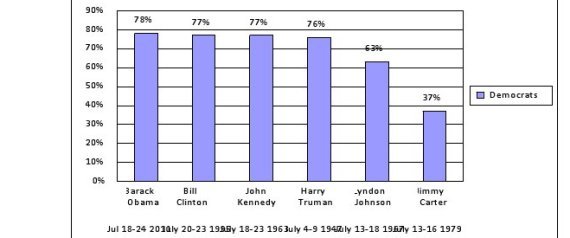
President Obama currently enjoys a higher popularity among Democratic voters than every Democratic president dating back to Harry Truman had at similar junctures in their presidencies.

According to Gallup's presidential job approval data, Obama had a 78 percent approval rating among Democrats from July 18 to July 24, 2011. Bill Clinton, meanwhile, had a 77 percent approval rating among Democrats from July 20 to July 23, 1995. Before him, Jimmy Carter had a 37 percent approval rating among Democrats from July 13 to July 16, 1979. Before him, Lyndon Johnson had a 63 percent approval rating among Democrats from July 13 to July 18, 1967. Before him, John F. Kennedy had a 77 percent approval rating among Democrats from July 18 to July 23, 1963. And before him, Harry Truman had a 76 percent approval rating percent among Democrats from July 4 to July 9, 1947.

Obama's approval ratings compared to former presidents at the same time: July 18-24 (Democrats only)

The numbers don't tell the full story. Only two of those presidents, Truman and Clinton, would go on to win reelection. In Carter's case, moreover, that 37 percent approval rating among Democrats represented a near-nadir -- it would be back up to 67 percent by the turn of 1980.

But for the Obama re-election campaign, the side-by-side comparison is an advantageous one. For starters, there is time for the president to improve on his 78 percent. More importantly, his popularity among Democrats has remained consistent even after he threw the party's sacred cows -- Social Security and Medicare -- into the deficit hysteria mix.
Posted by MAG at 11:28 AM No comments:
Newer Posts Older Posts Home
Subscribe to: Posts (Atom)

Badass

Badass

Followers

Blog Archive

  • ▼  2019 (1)
    • ▼  October (1)
      • Summer
  • ►  2018 (135)
    • ►  December (1)
    • ►  November (53)
    • ►  October (81)
  • ►  2017 (10)
    • ►  October (3)
    • ►  January (7)
  • ►  2016 (298)
    • ►  December (113)
    • ►  November (36)
    • ►  October (11)
    • ►  September (11)
    • ►  August (17)
    • ►  July (98)
    • ►  June (12)
  • ►  2015 (33)
    • ►  March (30)
    • ►  January (3)
  • ►  2014 (357)
    • ►  November (1)
    • ►  October (3)
    • ►  September (1)
    • ►  July (7)
    • ►  June (9)
    • ►  May (6)
    • ►  April (32)
    • ►  March (116)
    • ►  February (85)
    • ►  January (97)
  • ►  2013 (1007)
    • ►  December (90)
    • ►  November (68)
    • ►  October (163)
    • ►  September (70)
    • ►  August (30)
    • ►  July (73)
    • ►  June (53)
    • ►  May (62)
    • ►  April (89)
    • ►  March (166)
    • ►  February (97)
    • ►  January (46)
  • ►  2012 (1021)
    • ►  December (98)
    • ►  November (145)
    • ►  October (102)
    • ►  September (101)
    • ►  August (202)
    • ►  July (68)
    • ►  June (26)
    • ►  May (28)
    • ►  April (53)
    • ►  March (67)
    • ►  February (73)
    • ►  January (58)
  • ►  2011 (2506)
    • ►  December (57)
    • ►  November (145)
    • ►  October (247)
    • ►  September (222)
    • ►  August (280)
    • ►  July (67)
    • ►  June (76)
    • ►  May (214)
    • ►  April (294)
    • ►  March (298)
    • ►  February (313)
    • ►  January (293)
  • ►  2010 (4057)
    • ►  December (277)
    • ►  November (233)
    • ►  October (211)
    • ►  September (193)
    • ►  August (300)
    • ►  July (248)
    • ►  June (393)
    • ►  May (413)
    • ►  April (289)
    • ►  March (600)
    • ►  February (419)
    • ►  January (481)
  • ►  2009 (2477)
    • ►  December (464)
    • ►  November (271)
    • ►  October (302)
    • ►  September (271)
    • ►  August (232)
    • ►  July (193)
    • ►  June (112)
    • ►  May (127)
    • ►  April (242)
    • ►  March (131)
    • ►  February (52)
    • ►  January (80)
  • ►  2008 (304)
    • ►  December (85)
    • ►  November (219)