Thursday, July 28, 2011

FL Tea Party believe federal protection of manatees part of United Nations conspiracy of manatee over man #p2 #tcot

from http://thinkprogress.org/green/2011/07/28/281785/nugent-tea-party-manatees/

Florida Tea Party members believe that federal efforts to protect manatees from extinction are part of a United Nations conspiracy to place manatee over man. Freshman Rep. Rich Nugent (R-FL) is now standing up for the Tea Partiers against the feared manatee overlords, offering an amendment to the FY 2012 Interior and Environment appropriations bill (HR 2584) that would block the creation of a manatee refuge in Citrus County:

U.S. Rep. Rich Nugent is asking Congress to withhold funding for a proposed manatee-protection rule involving Crystal River and King's Bay, effectively stopping the rule before it starts.

The planned refuge would place speed limits on motor boats, to protect the nearly extinct species of herbivorous, aquatic mammals from maiming, disfigurement, and death.

Other crazed amendments offered to the FY 2012 Interior and Environment appropriations bill:

Scott (R-GA): None of the funds for climate change research.

Fahrenthold (R-TX): None of the funds to interfere with States' efforts to regulate hydraulic fracturing.

Blackburn (R-TN): Prohibits the appropriated agencies from buying compact fluorescent light bulbs.

Blackburn (R-TN): Bar funding for the SunWise Program, an EPA program to teach parents, teachers, and children about what they should do to protect kids from overexposure to the sun.

Fleming (R-LA): Eliminate funding for the Energy Star program.

Flores (R-TX): None of the funds to enforce section 526 of the Energy Independence and Security Act of 2007 to prohibit federal purchases of high-carbon fuels.

Lankford (R-OK): None of the funds for the President's Council on Environmental Quality.

King (R-IA): None of the funds to enforce the Oil Spill Prevention, Control, and Countermeasure Program.

Stivers (R-OH): None of the funds to regulate stationary source greenhouse gases for two years.


tea-party DICKS fire back at Sen. John McCain (R-Ariz.) who mocked them as “tea-party hobbits” #p2 #tcot

from http://www.politico.com/news/stories/0711/60151.html

Paul: 'Rather be a hobbit than a troll'
By: Scott Wong and Manu Raju
July 28, 2011 01:20 PM EDT

The "Lord of the Rings" metaphors crept into the debt-limit fight on Thursday, as tea-party heroes fired back at Sen. John McCain (R-Ariz.) who mocked members of the conservative grassroots movement as "tea-party hobbits."

"I'd rather be a hobbit than a troll," freshman Sen. Rand Paul (R-Ky.) said on a conference call when asked by POLITICO about McCain's remarks. "I think in reading the books, the hobbits were the heroes. They overcame great obstacles, and I think I'd rather be a hobbit than a troll."

Added fellow freshman Sen. Mike Lee, who co-founded the chamber's tea party caucus with Paul and Sen. Jim DeMint (R-S.C.): "It's stunning to me that some people have resorted to name calling rather than simply addressing the issue."

McCain, his party's presidential nominee in 2008, took to the Senate floor a day earlier, blasting tea-party lawmakers for opposing House Speaker John Boehner's plan to raise the debt ceiling because it doesn't require passage of a balanced budget amendment.

The five-term senator is a strong supporter of such an amendment but he dismissed their stance as "foolish," "deceiving and "bizarro," saying it is unrealistic the proposed amendment could win the 67 votes needed to clear the Democratic-controlled Senate.

Quoting from a Wall Street Journal editorial, McCain said "tea-party hobbits" were mistaken to think that if Republicans refuse to raise the debt ceiling and the government defaults on its loans, President Barack Obama would get the blame.

"This is the kind of crack political thinking that turned [tea-party heroes] Sharron Angle and Christine O'Donnell into GOP Senate nominees," McCain said, citing the editorial.

Angle shot back in a series of rapid-fire tweets Wednesday night, then hit McCain in a statement Thursday noting that the senator picked tea-party darling Sarah Palin as his 2008 running mate and ran to the right last year as he fended off a tough primary challenge.

"This man campaigned for TEA Party support in his last re-election, but now throws Christine O'Donnell and I into the harbor with Sarah Palin," said Angle, who tried to unseat Senate Majority Leader Harry Reid (D-Nev.) last year.

"As in the fable, it is the hobbits who are the heroes and save the land," she added. "This Lord of the TARP actually ought to read to the end of the story and join forces with the TEA Party, not criticize it."

While McCain's views may be shared at the highest-levels of the Senate, he probably won't be getting much public support from his GOP colleagues either.

Sen. John Cornyn (R-Texas), who is seeking to move up to the No. 2 in the leadership next Congress, needs tea party support to succeed in 2012 Senate elections, which he oversees as chairman of the National Republican Senatorial Committee.

In an interview Thursday, Cornyn told POLITICO that he didn't agree with McCain.

"I think what we're trying to do is accomplish a goal and I think it's best articulated by the Cut, Cap and Balance proposal which was killed by Senate Democrats," Cornyn said. "I think everybody is experiencing their own frustrations – over here we are with such little time between now and next Tuesday and a default. I don't share Sen. McCain's views about the Balanced Budget Amendment. I hope we can pass it in the House, and also in the Senate."

Rep. Marlin Stutzman (R-Ind.), a tea party-backed freshman, has come around to supporting the Boehner plan but took issue with McCain's invectives.

"Call them hobbits, call them what you like. I call the tea party and others who wish to fight to get this country on a proper fiscal trajectory, true patriots," Stutzman said on the House floor Thursday. "The reality here on earth, Mr. Speaker, is that America is a great nation and we wish to remain that way."

But Democrats were quick to seize on McCain's remarks.

In his floor speech Thursday morning, Reid - who has a frosty relationship with the senior senator from Arizona - highlighted his comments to attack Republicans. Democrats have put the clip on YouTube as well.

"Yesterday on the Senate floor, John McCain, the Republican senior senator from Arizona and President Obama's opponent in the last presidential election, asked his own party to return to reality," Reid said on the floor.

"It would be easy for Republicans to get nearly everything they want, if only they embraced the Senate's true compromise plan – and stop, as Sen. McCain put it, 'deceiving' the American people," Reid said.


It’s a Record-Setting Heat Wave, but the Conservative Media Deny Even That #P2 #TCOT

FROM http://thinkprogress.org/romm/2011/07/27/281085/record-heat-wave-conservative-media/

https://blogger.googleusercontent.com/img/b/R29vZ2xl/AVvXsEgF6YSP_bR4C-FH0qoN2VsSyqKasfG1UZW3cFXFEY9-pDfuLqJ7m0uOJZvQHlaCP6Ja6EGRLXtbjHNcE9WgnImcWz9JW5LfcvCOKSVTTTjnCmtgjsNZVmlFLXPWEATdACejbZ_EfUvdmCe2/s1600/temp_records.ratio.072311.jpg

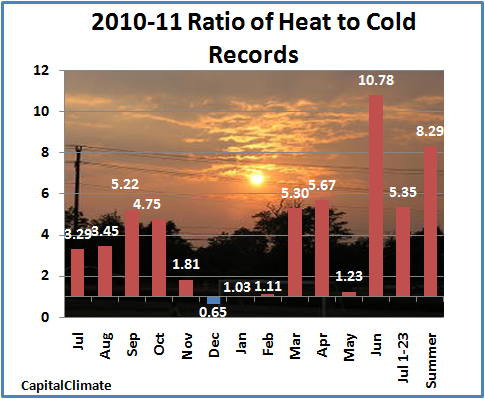
Monthly ratio of daily high temperature records vs low ones set in the U.S. for June 2010 through July 23, 2011, data from NOAA.

One way to tell if a nationwide heat wave is truly record-breaking is, well, to look at the total number of records that it breaks.  Even better is to compare the high records with the low records, since we have very good historical data and analysis on that — and it covers the whole nation.

Steve Scolnik at Capital Climate analyzed the data from NOAA's National Climatic Data Center (NCDC) and found, "U.S. Summer Heat Records Continue Overwhelming Cold Records By Over 8:1."  These large ratios for the summer and the first 23 days of July are a big deal  compared to, for instance, the  average over the last decade of about 2-to-1 (see "Mother Nature is Just Getting Warmed Up" and below).

But the conservative media can't even bring themselves to admit that, as Media Matters documents:

On his radio show yesterday, Rush Limbaugh declared that "almost no temperature records were broken" during the recent heat wave and that media outlets who reported on "record-breaking" heat were telling "a bunch of lies" to "advance a political agenda of liberalism."

Limbaugh's remarks echo a Newsbusters post in which Noel Sheppard claims that "almost no temperature records were actually broken." He came to this conclusion by ignoring most of the temperature records. Nevertheless, Sheppard's claim was picked up not only by Limbaugh but also Fox Nation:

fox nation headline

Citing the NOAA database, Sheppard claims "There were only 34 new all-time daily temperature records set during last week's 'record-breaking heat.' This is out of over 6000 records previously set for each day since such things have been reported."

Actually, it's not out of over 6000 records "set for each day," but out of over 6000 records set for all-time at each location. Sheppard is confusing all-time and daily records.

See, NOAA keeps track of records for different time scales: The daily record compares the temperature on July 24, for instance, to the temperature on every previous July 24; the monthly record compares the temperature on July 24 to the temperature of any day in July of any year; and the all-time record compares the  temperature on July 24 to the temperature of any day in any year. On top of that, NOAA provides these records for both the highest maximum temperature and the highest minimum (nighttime) temperature.

Sheppard is reporting the all-time records, describing them as though they are daily records, and ignoring everything else.

Here's the data (from NOAA) on the number of U.S. records broken or tied in the month of July so far:

  • All-Time Highest Maximum Temperature: 70
  • All-Time Highest Minimum Temperature: 175
  • Monthly Highest Maximum Temperature: 125
  • Monthly Highest Minimum Temperature: 330
  • Daily Highest Maximum Temperature: 2,125
  • Daily Highest Minimum Temperature: 4,787

Downplaying the heat wave, Limbaugh claimed "It does this every year." Is that true?

Not according to Christopher Vaccaro, a spokesman for the National Weather Service who told the New York Times that "this is different":

"One could say, 'Oh, it's summer, its late July, it's hot,' " said Christopher Vaccaro, a spokesman for the National Weather Service. "But this is different."

According to Mr. Vaccaro, this heat wave is exceptional not only for its strength, but also for its breadth and duration.

Meteorologist Jason Samenow wrote that "It's the humidity the sets this heat wave apart – not just in D.C., but over large parts of the country and for a long duration." Samenow added:

To conclude: where it's been dry, the day time heat has been unusual; elsewhere, the night time heat and humidity has been unusual. It will take more time and analysis to objectively rank where this heat wave stacks up in the record books, but it's clear that it's far from the ordinary.

Jeff Masters, Director of Meteorology for the Weather Underground, writes that "July 2011 is on pace to be one of the five hottest months in U.S. history, but may have a tough time surpassing the hottest month of all time, July 1936." Masters added that in contrast to the 1930s heat waves, the humidity during the most recent heat wave was high:

The heat index–how hot the air feels when factoring in both the temperature and the humidity–has been exceptionally high during this week's heat wave, due to the presence of very high amounts of water vapor in the atmosphere. That has made this heat wave a very dangerous one, since the body is much less able to cool itself when the humidity is high….

During the 1930s, there was a high frequency of heat waves due to high daytime temperatures resulting in large part from an extended multi-year period of intense drought. By contrast, in the past 3 to 4 decades, there has been an increasing trend in high-humidity heat waves, which are characterized by the persistence of extremely high nighttime temperatures.

Masters further stated that global warming makes heat waves like this one more likely to occur. Indeed, we've noted that scientists expect heat waves to become "more intense, more frequent and longer-lasting" as a result of human-induced climate change.

Which brings us to the question of why conservative media figures feel the need to downplay last week's scorching heat. Apparently, a distaste for policies designed to address climate change has led some to reject the scientific consensus that humans are changing the climate, which has, in turn, led them to deny the validity of the evidence supporting human-induced climate change and denounce climate-related information as "propaganda."

And now Limbaugh has dug himself into such a hole that he feels he can't even acknowledge an unusually intense heat wave and has to attack the heat index as a figure "manufactured by the government." It's clear that to Limbaugh, weather and climate data aren't information to consider, but a "weapon" to use in political battles.

The many businesses and public entities that provide services affected by changing weather patterns don't have that luxury.

Let's return to the ratio of daily record highs to lows, from the 2009 National Center for Atmospheric Research study of the past six decades (see "Record high temperatures far outpace record lows across U.S."):


temps

This graphic shows the ratio of record daily highs to record daily lows observed at about 1,800 weather stations in the 48 contiguous United States from January 1950 through September 2009. Each bar shows the proportion of record highs (red) to record lows (blue) for each decade. The 1960s and 1970s saw slightly more record daily lows than highs, but in the last 30 years record highs have increasingly predominated, with the ratio now about two-to-one for the 48 states as a whole.

NCAR explained their 2009 findings in a news release:

Spurred by a warming climate, daily record high temperatures occurred twice as often as record lows over the last decade across the continental United States, new research shows. The ratio of record highs to lows is likely to increase dramatically in coming decades if emissions of greenhouse gases continue to climb.

"Climate change is making itself felt in terms of day-to-day weather in the United States," says Gerald Meehl, the lead author and a senior scientist at the National Center for Atmospheric Research (NCAR). "The ways these records are being broken show how our climate is already shifting."

The scientific paper itself is here (subs. req'd).  And NCAR posted a video of lead author Meehl discussing his findings here.  The study looked into the future and found that "if nations continue to increase their emissions of greenhouse gases in a 'business as usual' scenario, the U.S. ratio of daily record high to record low temperatures would increase to about 20-to-1 by mid-century and 50-to-1 by 2100."

So the 8-to-1 ratio for this summer is indicative of a monster heat wave.  There's no denying that.


U.S. Summer Heat Records Continue Overwhelming Cold Records By Over 8:1 #P2 #TCOT

They haven't matched the incredible pace of June records, but U.S. temperature extremes this summer continue to overwhelmingly favor hot records vs. cold records. Through the 23rd, the number of daily high temperature records reported by the National Climatic Data Center (NCDC) in July outnumbered low temperature records by a ratio of over 5 to 1. Combined with June's torrid ratio of nearly 11 to 1, the ratio for the summer to date stands at 8.3 to 1. For the year 2011 to date, as well as the last 12 consecutive months, the ratio has risen to 2.6 to 1.

REST (AND GRAPHS) AT http://capitalclimate.blogspot.com/2011/07/us-summer-heat-records-continue.html

Rush Pushes Conspiracy Theory Involving Climate Change, Liberals, Heat Index, Record-Breaking Heat Wave #p2 #tcot

http://mediamatters.org/mmtv/201107250014


Rush Limbaugh declared that “almost no temperature records were broken” during the recent heat wave #p2 #tcot

from http://thinkprogress.org/green/2011/07/28/281732/now-theyre-even-denying-the-weather/


Now They're Even Denying The Weather | On his radio show Monday, Rush Limbaugh declared that "almost no temperature records were broken" during the recent heat wave and that media outlets who reported on "record-breaking" heat were telling "a bunch of lies" to "advance a political agenda of liberalism." Fox News repeated Limbaugh's insane claim:

In reality, thousands of records were broken, and U.S. temperature extremes this summer continue to overwhelmingly favor hot records vs. cold records. (HT: Joe Romm)

117 Members Of Congress Join Letter Calling For DOJ Action Against GOP war on voting #p2 #tcot

from http://thinkprogress.org/justice/2011/07/28/281314/house-supports-voting/

Earlier this month, 16 senators sent a letter to Attorney General Eric Holder calling for DOJ to examine whether the voter ID laws, which are the centerpiece of the GOP's war on voting, violate the Voting Rights Act. Earlier this week, over 100 members of the House of Representatives wrote to Holder echoing this call for the Justice Department to take action to preserve America's democracy:

Approximately 11 percent of voting-age citizens in the country — or more than 20 million individuals — lack government-issued photo identification. We urge you to protect the voting rights of Americans by using the full power of the Department of Justice to review these voter identification bills and scrutinize their implementation.

The Voting Rights Act vests significant authority in the Department to ensure laws are not implemented in a discriminatory manner. [...] [T]he Department should exercise vigilance in overseeing whether these laws are implemented in a way that discriminates against protected clauses in violation of Section 2 of the Voting Rights Act.

The VRA not only forbids laws that are passed specifically to target minority voters but also strikes down state laws that have a greater impact on minority voters than on others. Because voter ID laws disproportionately affect minority communities, it is difficult to see how many of the voter ID laws being pushed in GOP-controlled states could survive scrutiny under this law.


Exxon Pays a Lower Effective Tax Rate than the Average American #P2 #TCOT

FROM http://www.americanprogress.org/issues/2011/05/tax_man.html

Exxon Mobil Dodges the Tax Man

Exxon Pays a Lower Effective Tax Rate than the Average American

Gas prices above five dollars a gallon are seen on a sign at a gas station in Washington.

SOURCE: AP/Susan Walsh

Léalo en español

Download full data on Exxon Mobil's effective tax rate from 2008 to 2010 (.xls)

Exxon Mobil Corp.'s robust balance sheets have become a poster child for what The New York Times dubs the "paradox of the United States tax code." 

The company's large 2010 profits allowed them to lead Fortune 500's annual ranking of the nations' most profitable firms for the eighth time in a row. But the oil giant's average effective tax rates are roughly half the 35 percent tax rate that currently stands as the high-water mark for American corporations. Meanwhile, Exxon Mobil and other big oil companies continue to exploit tax loopholes for nearly $4 billion in subsidies each year. These subsidies include write-offs for drilling costs and a deduction for domestic production that was intended for manufacturers, not big oil producers.

Exxon Mobil registered an average 17.6 percent federal effective corporate tax rate on its annual earnings in the three years spanning 2008 to 2010. Its average domestic profits exceeded $6.8 billion. And as a 2011 Citizens for Tax Justice report points out:

Over the past two years, ExxonMobil reported $9,910 million in pretax U.S. profits. But it enjoyed so many tax subsidies that its federal income tax bill was only $39 million—a tax rate of only 0.4 percent.

Even when Exxon Mobil had a record profit of $40 billion in 2008 due to record oil prices it had only a 31 percent effective tax rate. That's 13 percent lower than the maximum 35 percent despite being Exxon Mobil's fifth year as the top corporate earner in Fortune 500's annual listing. The company paid no taxes at all to the U.S. federal government in 2009 on its domestic profits of nearly $2.6 billion. It appears that they avoided the tax man that year by legally funneling their profits through wholly owned subsidiaries in countries like the Cayman Islands, and reinvesting their earnings overseas.

exxon's effective tax rate, 2008-2011

More striking still is the discrepancy between Exxon Mobil's rates and those of most American breadwinners. The company's effective rate of 17.6 percent is nearly 16 percent below the average individual federal tax rate, which according to the Congressional Budget Office was 20.4 percent as of 2007.

Individuals in the highest quintile pay an average tax rate just over 25 percent in the United States. Exxon Mobil, meanwhile, paid approximately the same effective tax rate as Americans in the fourth income quintile—which includes Americans earning from $62,000 to $100,000 a year.

Exxon Mobil's accounting methods mask its relatively low effective tax rate. According to CNN Money the $3.1 billion in taxes the company claims to have paid since January 2011 includes both federal and state gasoline taxes—that are really paid by drivers—as well as employee payroll taxes.

Think Progress's Pat Garofalo rightly observes that "Exxon is counting as part of its tax burden [taxes] that it simply does not pay," making the exorbitant subsidies the company receives even more unnecessary.

These strategic maneuverings have not been lost on congressional Democrats. Rep. Tim Bishop (D-NY) introduced a bill to repeal at least one of these tax loopholes for large oil companies including Exxon. The legislation would result in $12 billion in revenue over 10 years by removing the Section 199 domestic manufacturing tax deduction.

House Republicans successfully blocked Democratic attempts to force a vote erasing this unnecessary oil subsidy on May 5 by passing a motion, 241-171, on two drilling bills.

But this promises to be only a temporary respite for Big Oil tax breaks. And a short one at that. The Senate is expected to vote next week on the Close Big Oil Tax Loopholes Act, legislation introduced by Robert Menendez (D-NJ) and other senators to address oil prices and subsidies for the five biggest oil companies.

Seth Hanlon, Director of Fiscal Reform at the Center for American Progress, explains that the glaring contrast between:

Today's high gas prices and inflated profits have undermined the industry's argument that their tax breaks benefit consumers.

Meanwhile, federal budget deficits have sharpened Congress's focus on eliminating wasteful government spending—of which oil subsidies are one of the worst examples.

Right on cue, Rep. Max Baucus (D-MT), on the morning of May 6, called on executives from Exxon Mobil and its Big Five compatriots—BP, Chevron, ConocoPhillips, and Shell—to stand before the Senate Finance Committee for a May 12 hearing on "Oil and Gas Tax Incentives and Rising Energy Prices." As of this writing, top-level representatives from each company have confirmed attendance, including ExxonMobil Chairman and CEO Rex Tillerson. He now finds himself with the difficult task of publicly rationalizing Exxon's share of billions in subsidies, despite the company reaping enormous profits and paying relatively little in the way of taxes.

Léalo en español

Download full data on Exxon Mobil's effective tax rate from 2008 to 2010 (.xls)

Thanks to Seth Hanlon, Director of Fiscal Reform, Daniel J. Weiss, Senior Fellow and Director of Climate Strategy, and Tony Carrk, Policy Analyst at American Progress.

To speak with our experts on this topic, please contact:

Print: Anna Soellner (economic policy)
202.478.5322 or asoellner@americanprogress.org

Print: Anne Shoup (education policy)
202.481.7146 or ashoup@americanprogress.org

Print: Christina DiPasquale (foreign policy and security, energy)
202.481.8181 or cdipasquale@americanprogress.org

Print: Raúl Arce-Contreras (ethnic media, immigration)
202.478.5318 or rarcecontreras@americanprogress.org

Radio: Anne Shoup
202.481.7146 or ashoup@americanprogress.org

TV: Andrea Purse
202.741.6250 or apurse@americanprogress.org


Exxon and Shell Announce Massive Profit Gains — All the More to Spend on Influence Peddling and Climate Denial #P2 #TCOT

FROM http://thinkprogress.org/romm/2011/07/28/281465/exxon-and-shell-announce-massive-profit-gains-all-the-more-to-spend-on-influence-peddling-and-climate-denial/

More oil-company earnings figures out today — the latest from Shell and Exxon.

Exxon reported a whopping $10.7 billion in profits, an increase of 41% from the same period last year. Overall, Exxon has earned over $20 billion in profits in just the first six months of the year. Not surprisingly, ExxonMobil is also one of the most politically engaged of the top five oil companies. A few key facts:

ExxonMobil is also well known for giving millions of dollars to climate deniers and industry front groups with the goal of creating doubt about global warming, attacking the integrity of climate science and scientists, and promoting a pro-corporate polluter agenda.

Royal Dutch Shell announced their 2011 second-quarter earnings, reporting profits of $8 billion, a 77% jump from the same period a year ago, bringing their total profits in the first six months of 2011 to $14.9 billion. Below is a quick look at Shell by the numbers:


Shell Oil Profits Surge To $8 Billion #P2 #TCOT

FROM http://thinkprogress.org/green/2011/07/28/281453/shell-oil-profits-surge-to-8-billion/

|
Royal Dutch Shell announced their 2011 second-quarter financial results, reporting profits of $8 billion, a 77 percent jump from the same period a year ago, bringing their total profits in the first six months of 2011 to $14.9 billion. Shell has spent nearly $4 million on lobbying in 2011, making it one of the Top 20 Spenders of 2011, and the second biggest spender of the oil and gas industry. –Noreen Nielsen

BP Announces ‘Disappointing’ Profits Of $5.6 Billion #P2 #TCOT

FROM http://thinkprogress.org/green/2011/07/26/278938/bp-announces-profits-of-5-6-billion/

This morning, BP announced $5.6 billion in profits in the second-quarter of 2011, a decrease from Q1, "disappointing" investors who expected even more. Despite making $11 billion in profits in just 2011 alone, BP and its other Big Oil allies continue to aggressively lobby Congress to maintain their billions of dollars in oil industry tax breaks. A quick look at some other key facts:

– BP has already spent $2 million lobbying Congress this year.

– BP has made over $40,000 in political contributions in just 2011, with 93 percent going to Republicans.

– The Big Five oil companies — BP, Exxon, Chevron, ConocoPhillips and Shell — made more than $900 billion in profits (figure in 2011 dollars) – almost a trillion dollars – over the previous decade.

Moreover, BP — responsible for the worst oil spill in U.S. history, has only paid out $4 billion of the $20 billion fund set up to pay restitution to the economic victims of its Gulf of Mexico. BP claims that the Gulf Coast economy is booming, despite evidence that suggests otherwise.


Facts Behind the Oil Tax Loopholes and Windfall Profits - GET ANGRY #P2 #TCOT

FROM http://www.americanprogress.org/issues/2011/05/big_oil_numbers.html

Center for American Progress

Back to this item

Americans to Big Oil: We've Got Your Number

The Facts Behind the Oil Tax Loopholes and Windfall Profits

SOURCE: AP/Kirsty Wigglesworth

A sign at a BP petrol station is seen in London. Senate Democratic leaders are determined to stem unnecessary tax subsidies flowing to the five biggest oil companies—BP p.l.c, Chevron Corp., ConocoPhillips, Exxon Mobil Corp., and Royal Dutch Shell p.l.c.

The numbers don't lie. Tax loopholes allow Big Oil companies to ratchet up their annual earnings at the expense of American taxpayers. Well-placed campaign contributions to their congressional allies preserve these undeserved handouts.

Americans eager to reduce the mammoth federal debt that threatens our economy's long-term prosperity overwhelmingly support ridding the tax code of these unnecessary subsidies. As Seth Hanlon, Director of Fiscal Reform, and Michael Ettlinger, Vice President for Economic Policy at the Center for American Progress, explain, tax breaks for oil companies and other superfluous "spending in the tax expenditure budget is fertile ground for deficit reduction." But on May 5, Republicans unanimously voted down a Democratic attempt to put forward legislation that would end subsidies to oil companies. Seven Democrats also opposed the measure.

So here is a by-the-numbers examination of what Big Oil is costing us, plus a few examples of where the billions of dollars salvaged from their balance sheets might be better spent.

The cost of Big Oil's loopholes

  • $4 billion: Cost of Big Oil tax breaks in 2011.
  • $2 billion: Cost of Big Oil tax breaks eliminated by S. 940.
  • $77 billion: Cost of Big Oil tax breaks from 2011 to 2021.

Big Oil profits pile up

  • $902 billion: Total profits for the five biggest oil companies in the United States, 2001–2010 (in 2011 dollars).
  • $32 billion: Total Big Oil earnings, first quarter of 2011. Exxon Mobil alone accounted for $10.7 billion of that figure.
  • 38 percent: Big Oil's first-quarter-2011 profit increase over the first quarter of 2010.
  • 28 percent: Increase in gasoline prices compared to 2010.
  • 53 percent: Portion of their profits that both Exxon Mobil and ConocoPhillips spent repurchasing stock to drive up their companies' share values in the first quarter of 2011.
  • $8 billion: The amount of first-quarter profits the big five companies spent on stock buybacks.

Low effective tax rates for Exxon Mobil

  • 17.6 percent: Average effective federal corporate tax rate paid by Exxon Mobil, 2008–2010.
  • 20.4 percent: Average American individual federal effective tax rate in 2007 (the last year of available data).

Oil campaign cash and votes to close loopholes

  • $273,500: Big Oil campaign contributions to Republican senators and representatives in the first quarter of 2011.
  • $7,000: Big Oil campaign contributions to Democratic senators and representatives in the first quarter of 2011.
  • 2: House Republicans who voted to cut tax loopholes for Big Oil during debate on H.R. 1230.
  • 147: House Democrats who voted to cut tax loopholes for Big Oil during debate on H.R. 1230.
  • 0: House Democrats who voted for $30 billion in Medicare cuts in the FY 2012 budget resolution that was passed by the House on April 15.
  • 4: Republicans who voted against $30 billion in Medicare cuts in the FY 2012 budget.
  • 44: Senators who voted to close Big Oil tax loopholes and use savings to offset health care costs.

Public supports ending tax breaks

What oil tax dollars could buy

  • $21 billion reduction in the federal budget deficit by enactment of the Close Big Oil Tax Loopholes Act (S. 940), which would close tax loopholes for the big five oil companies over the next 10 years.
  • $30 billion for Medicare if tax loopholes were eliminated for all Big Oil companies. This would offset the Medicare cuts in the fiscal year 2012 budget resolution that was passed by the House on April 15.
  • $1 billion could pay the salaries of 18,000 high school teachers earning an average of $55,000 per year.
  • $1 billion could pay for 251,000 Pell Grants to aspiring college students. These grants are essential to help these scholars pay for tuition, and averaged $3,984 apiece in 2011.

Senate Democratic leaders are determined to stem these unnecessary subsidies flowing to the five biggest oil companies—BP p.l.c., Chevron Corp., ConocoPhillips, Exxon Mobil Corp., and Royal Dutch Shell p.l.c. The Senate is expected to vote next week on the Close Big Oil Tax Loopholes Act (S. 940), introduced by Sens. Robert Menendez (D-NJ), Sherrod Brown (D-OH), Claire McCaskill (D-MO), and 24 other senators. It would close $2 billion worth of tax loopholes for these five companies. Senate Majority Leader Harry Reid (D-NV) and Finance Chairman Max Baucus (D-MT) also support cutting off the corporate welfare given to these oil companies.

On May 12, the CEOs of the big five oil companies will testify about these tax loopholes before the Senate Finance Committee. Hopefully they will explain how they can justify spending billions of dollars on these tax loopholes when other priorities face severe cuts.

Daniel J. Weiss is a Senior Fellow and Director of Climate Strategy at the Center for American Progress. Valeri Vasquez is a Special Assistant on the Center's Energy Opportunity policy team.

To speak with our experts on this topic, please contact:

Print: Anna Soellner (economic policy)
202.478.5322 or asoellner@americanprogress.org

Print: Anne Shoup (education policy)
202.481.7146 or ashoup@americanprogress.org

Print: Christina DiPasquale (foreign policy and security, energy)
202.481.8181 or cdipasquale@americanprogress.org

Print: Raúl Arce-Contreras (ethnic media, immigration)
202.478.5318 or rarcecontreras@americanprogress.org

Radio: Anne Shoup
202.481.7146 or ashoup@americanprogress.org

TV: Andrea Purse
202.741.6250 or apurse@americanprogress.org


FIGHTING OVER DEBT CEILING - GLAD BIG OIL MADE BILLIONS #P2 #TCOT

http://www.americanprogress.org/issues/2011/05/big_oil_numbers.html

Wednesday, July 27, 2011

Religious groups set prayer vigil for U.S. debt deal #p2 #tcot

from http://www.reuters.com/article/2011/07/26/us-usa-debt-prayer-idUSTRE76P07520110726

(Reuters) - Across the street from the U.S. Capitol in the small north lawn of the United Methodist Building, Christians, Muslims and Jews will pray on Tuesday for the country's budget, and hope to teach Republicans and Democrats a lesson in compromise.

So far, nothing else has worked, not even President Barack Obama's cajoling or warnings from Wall Street titans that a failure to promptly raise U.S. borrowing authority would result in economic Armageddon.

As the 435 members of the House of Representatives and 100 senators do battle inside the Capitol, some 100 religious faithful will try a different approach to convert debt limit doubters -- a daily prayer vigil.

But it's not just any budget deal these activists want to settle for in return for raising U.S. borrowing authority.

The vigils will be a way of lobbying against any deal that slashes too much from programs that protect the underprivileged, like nutrition programs for the poor or health care for the poor and disabled.

"I hope that it's not only effective but a model for how Democrats and Republicans, who differ on many issues, can come together on a common issue to move the country forward," said Rabbi David Saperstein, executive director of the Religious Action Center of Reform Judaism.

(Reporting by Lily Kuo; Editing by Cynthia Johnston)

(This story was corrected to change the name of the rabbi quoted in last paragraph)


If Tea Party Likes a Debt Deal, It Can't Pass: Economist #p2 #tcot

from http://www.cnbc.com/id/43906649

As the high risk-game of chicken over raising the US debt ceiling draws closer to possible economic collision, one economist is warning that any deal that wins approval from the right-wing Tea Party movement will pass neither the Senate nor the president.

"As the Tea Partiers are showing no indications of being willing to compromise at all, the only way a deal can be done is for moderate House Republicans—those who appreciate that default would be hugely damaging for the country—to side with Democrats to pass a bill that the Senate and the president can sign," Ian Shepherdson, chief US economist at High Frequency Economics said in a research note on Wednesday.

As things stand, such a solution looks very unlikely in the coming days. The latest plan from House Speaker John Boehner needs revising following Congressional Budget Office experts warning it would not deliver on the spending cuts it claimed. That plan is likely to be voted on by Congress on Thursday.

President Barack Obama's Chief of Staff, Bill Daley, told CNBC on Tuesday that he is confident that some kind of plan will pass. The head of global sovereign ratings at S&P has told CNBC that the US could prioritize debt payments to avoid default but warned such action would be "deeply disruptive" to the US economy.

A problem for the Republican Party could be that the majority of Americans now back a debt ceiling [cnbc explains] plan that involves both spending cuts and tax hikes. A Reuters/Ipsos poll this week found that 56 percent of American's favor a plan involving both cuts and tax increases.

"We had hoped by now that House Speaker Boehner would have started to recognize this reality, but press reports suggest that he focused on party solidarity in his conference call with Republican House members," said Shepherdson.

"Perhaps the light bulb will come on when the inevitable pushback from voters becomes overwhelming. We can only hope that happens before August 2," Shepherdson said.

© 2011 CNBC.com