OBAMA WON THE ELECTION - AWESOME. SO NOW ITS MY DUTY TO WATCH THE NEWS ON OBAMA, COLLECT IT AND PASS IT ON TO YOU. WE NEED TO MAKE SURE HE KEEPS HIS WORD AND LIVES UP TO HIS IDEALS AND PROMISES.
President-elect Donald Trump said he was contacted by Sprint executives today and told that the company was making an investment in domestic jobs, according to Reuters and Bloomberg. "Because of what's happening and the spirit and the hope I was just called by the head people at Sprint and they're going to be bringing 5,000 jobs back to the United States," Trump said outside his Mar-A-Lago resort in Florida. "Masa [Son] and some other people were very much involved with that."
Sprint issued a press release, patting itself on the back for the deal. "We are excited to work with President-Elect Trump and his administration to do our part to drive economic growth and create jobs in the U.S." CEO Marcelo Claure said in the statement.
"We believe it is critical for business and government to partner together to create more job opportunities in the U.S. and ensure prosperity for all Americans."
"I just spoke with the head person," Trump told Bloomberg. "He said because of me they're doing 5,000 jobs in this country."
Here's the problem: Despite what Trump and the press release from Sprint said (and what its CEO recently tweeted), these jobs were part of a previous announcement from Softbank (Sprint's parent company) CEO Masayoshi Son -- not the direct result of working with Trump.
Trump and Sprint simply put out PR and everyone rewrote it. Sprint ignored inquiries from reporters who figured it out, only admitting that the jobs were "previously announced" after the company became the story and things started getting hot.
When I reached out to a Sprint spokeswoman asking if the announcement was a direct result of working with Trump or part of a pre-existing deal, she copy and pasted the press release I'd sent along with my first email. I responded saying I already had the press release and asked again if this was a direct result of working with Trump or part of a pre-existing deal in place. I tagged Sprint in a tweet about the situation, and it wasn't until after that started getting retweeted that the spokesperson responded.
"This is part of the 50,000 jobs that Masa previously announced," she said. "This total will be a combination of newly created jobs and bringing some existing jobs back to the U.S."
This is how it's going to be: he lies, and reporters instantly launder the statement into impartial-sounding headlines in the rush to be first. The excuse will be that stenography is journalism.
In 2004, under then-governor Rick Perry, the Texas Education Agency secretly instituted a plan to cap the number of students receiving special education support at 8.5% -- far less than the national average.
In order to achieve this goal, the state forced teachers to illegally, systematically deny care to children, including speech therapy, psychological counseling, physical therapy, and access to therapeutic tools (for example, at least one student who was born without functional hands was denied the laptop he needed to do his schoolwork).
Many of those kids went on to drop out, but Texas also leads the country in its pipeline for kids sent to mental institutions, and the Houston Chronicle's six-part series on the policy also documents suicides and attempted suicides.
All along -- and even now -- the state and the local school districts deny that the policy exists, despite the testimonies of parents, students, and long-serving principals and teachers who quit rather than go along with orders. The state and local education authorities have also illegally refused to respond to public records requests.
Despite this stonewalling and lying, the Houston Chronicle has pieced together a damning, thorough documentation of the Rick Perry legacy: tens, if not hundreds, of thousands of children who were denied the education they were entitled to, who ended up uneducated, institutionalized, overmedicated, or dead -- all to save the state more than a billion dollars it was required, by law, to spend on its children. As you might expect: this policy landed disproportionately on racialized brown and black children.
Rick Perry is no longer governor of Texas: now he's America's problem, as Trump's pick for Secretary of Energy.
Trump and the GOP are about to unleash a series of policies that will almost exclusively benefit the rich and their corporations, who are already experiencing record profits.
And while the economy is being devoured by those who need it the least, Trump will deliver his symbolic and highly effective PR stunts that save a few jobs while everything else he can to hollow out the middle class.
Another #fakenews story is being promoted by the Great Lakes Education Project (GLEP), Betsy DeVos's personally founded and funded school privatization guerrilla organization in Michigan. The mother quoted here, Maria Salazar, has been writing a version of this article for Betsy-DeVos-funded organizations since at least 2013: this one, from the American Federation for Children–a DeVos voucher front group–introduces us to Maria's daughter, who has seemingly been "rescued" from her public school through the generosity of Betsy DeVos herself…
The Corporate Tuition Tax Credit Scholarship program changed her life and gave her opportunities her single mother Maria could not have afforded on her own. Maria and Nydia immigrated to the U.S. from Peru when Nydia was a small child.
"When we arrived in the U.S. I told Nydia that if I work hard to support us and she works hard to learn in school, we would find the opportunities we came here for," says Maria Salazar. "I was so relieved, excited and, most of all, grateful when I found out Nydia would have a scholarship to attend St. Mary's. It was everything I promised Nydia all those years ago."
Similar "news articles" from the past several years on Ms. Salazar's adventures in voucher marketing can be found here and here, from 2013, and here, in 2014. In fact, promoting Betsy's voucher plans seems to be something of a side job for Ms. Salazar.
Let's interject a little bit of context here: The AZ voucher program is actually a set of 5 different programs, and they have collectively been a disaster for Arizona by virtually any measure.
Trump claimed almost a billion of tax losses on his 1995 tax return. Trump did not lose anything like that in economic substance because he never put that much money into his transactions. If he never put it, he did not lose it. Trump must have treated part of the $3.4 bank debt as a cost and tax basis, while inconsistently, not correcting his cost when it turned out not be paid. Sheppard and Lipton have proposed an S corporation or Gitlitz theory, which if applicable would allow the fake loss as a tax deduction, but real estate developers did not use S corporations in the early and middle 1990's because S corporations trapped all losses inside the corporation where they were wasted. Trump might have reduced basis in real property, rather than taking an immediate income or NOL reduction. In any event, the losses do not "impinge on the world" and courts take away fake tax losses when they see them.
"Legal" means that a court would uphold the tax loss when fully aware of the facts and with capable briefing by adversaries. The standards for reporting losses allow the taxpayer to report that this loss might be available, but it probably is not. "Legal" does not include claims that were not caught by a smart agent, which were in fact fraudulent.
The legality of Trump's claimed losses has some bearing on the current election. Even beyond the election, we need to understand his claim to ensure that such an awful result never happens again.
During Donald Trump's presidential campaign, he touted his financial independence, stating that he would not be owned by donors or special interests the way establishment politicians might be. While it remains to be seen whether Trump's policies in office will be influenced by his backers, he has been giving them significant access since his election, and choosing a number of them for cabinet positions, according to a report by Politico.
The report, which was based on Federal Election Commission records, shows that more than one third of the people who Trump took meetings with since winning the election gave significant donations to either his campaign or Republicans in general. The 73 donors reportedly gave a total of $1.7 million to Trump and groups that supported him, and more than $57 million to the GOP. On top of that, 38 percent of those who Trump has named to government positions so far have been big donors. Picking supporters for positions is nothing new, but the degree to which Trump is favoring his financial backers is, the report states.
Facebook has long let users see all sorts of things the site knows about them, like whether they enjoy soccer, have recently moved, or like Melania Trump.
But the tech giant gives users little indication that it buys far more sensitive data about them, including their income, the types of restaurants they frequent and even how many credit cards are in their wallets.
Since September, ProPublica has been encouraging Facebook users to share the categories of interest that the site has assigned to them. Users showed us everything from "Pretending to Text in Awkward Situations" to "Breastfeeding in Public." In total, we collected more than 52,000 unique attributes that Facebook has used to classify users.
Download the Facebook interest category and ad group data ProPublica collected to report this story, available now via the ProPublica Data Store.
Facebook's site says it gets information about its users "from a few different sources."
What the page doesn't say is that those sources include detailed dossiers obtained from commercial data brokers about users' offline lives. Nor does Facebook show users any of the often remarkably detailed information it gets from those brokers.
"They are not being honest," said Jeffrey Chester, executive director of the Center for Digital Democracy. "Facebook is bundling a dozen different data companies to target an individual customer, and an individual should have access to that bundle as well."
When asked this week about the lack of disclosure, Facebook responded that it doesn't tell users about the third-party data because it's widely available and was not collected by Facebook.
"Our approach to controls for third-party categories is somewhat different than our approach for Facebook-specific categories," said Steve Satterfield, a Facebook manager of privacy and public policy. "This is because the data providers we work with generally make their categories available across many different ad platforms, not just on Facebook."
Satterfield said users who don't want that information to be available to Facebook should contact the data brokers directly. He said users can visit a page in Facebook's help center, which provides links to the opt-outs for six data brokers that sell personal data to Facebook.
Limiting commercial data brokers' distribution of your personal information is no simple matter. For instance, opting out of Oracle's Datalogix, which provides about 350 types of data to Facebook according to our analysis, requires "sending a written request, along with a copy of government-issued identification" in postal mail to Oracle's chief privacy officer.
Users can ask data brokers to show them the information stored about them. But that can also be complicated. One Facebook broker, Acxiom, requires people to send the last four digits of their social security number to obtain their data. Facebook changes its providers from time to time so members would have to regularly visit the help center page to protect their privacy.
One of us actually tried to do what Facebook suggests. While writing a book about privacy in 2013, reporter Julia Angwin tried to opt out from as many data brokers as she could. Of the 92 brokers she identified that accepted opt-outs, 65 of them required her to submit a form of identification such as a driver's license. In the end, she could not remove her data from the majority of providers.
ProPublica's experiment to gather Facebook's ad categories from readers was part of our Black Box series, which explores the power of algorithms in our lives. Facebook uses algorithms not only to determine the news and advertisements that it displays to users, but also to categorize its users in tens of thousands of micro-targetable groups.
Our crowd-sourced data showed us that Facebook's categories range from innocuous groupings of people who like southern food to sensitive categories such as "Ethnic Affinity" which categorizes people based on their affinity for African-Americans, Hispanics and other ethnic groups. Advertisers can target ads toward a group — or exclude ads from being shown to a particular group.
Last month, after ProPublica bought a Facebook ad in its housing categories that excluded African-Americans, Hispanics and Asian-Americans, the company said it would build an automated system to help it spot ads that illegally discriminate.
A West Virginia county official who insulted Michelle Obama with racist Facebook posts has been removed from her job.
Pamela Taylor, who served as executive director of the Clay County Development Corporation, was relieved of her duties after the state reached an agreement with the nonprofit organization's board of directors, reported the Charleston Gazette-Mail.
Taylor drew national attention after making a racist comparison between the First Lady and her successor, Melania Trump.
"It will be refreshing to have a classy, beautiful, dignified First Lady in the White House," Taylor wrote. "I'm tired of seeing an ape in heels."
Beverly Whaling resigned as mayor of Clay after praising Taylor's post, saying it "made my day."
Taylor was suspended for her comments but was later reinstated — which state officials said put the Clay County Development Corporation's federal and state funding in jeopardy.
Gov. Earl Ray Tomblin's office issued a statement Tuesday saying that Taylor would be removed and the Appalachian Area Agency on Aging would manage the development corporation for six months.
The statement did not list Taylor's social media activity.
State officials said the CCDC was not following state nonprofit law regarding open meetings, public record requests and issues related to its board structure.
The Agency on Aging will be allowed to hire and fire staff members and recommend changes to the CCDC's bylaws, and the agency will also reorganize the department's board of directors.
The development corporation received about $1.5 million in federal funding and $363,000 in state funding in 2014, according to tax records.
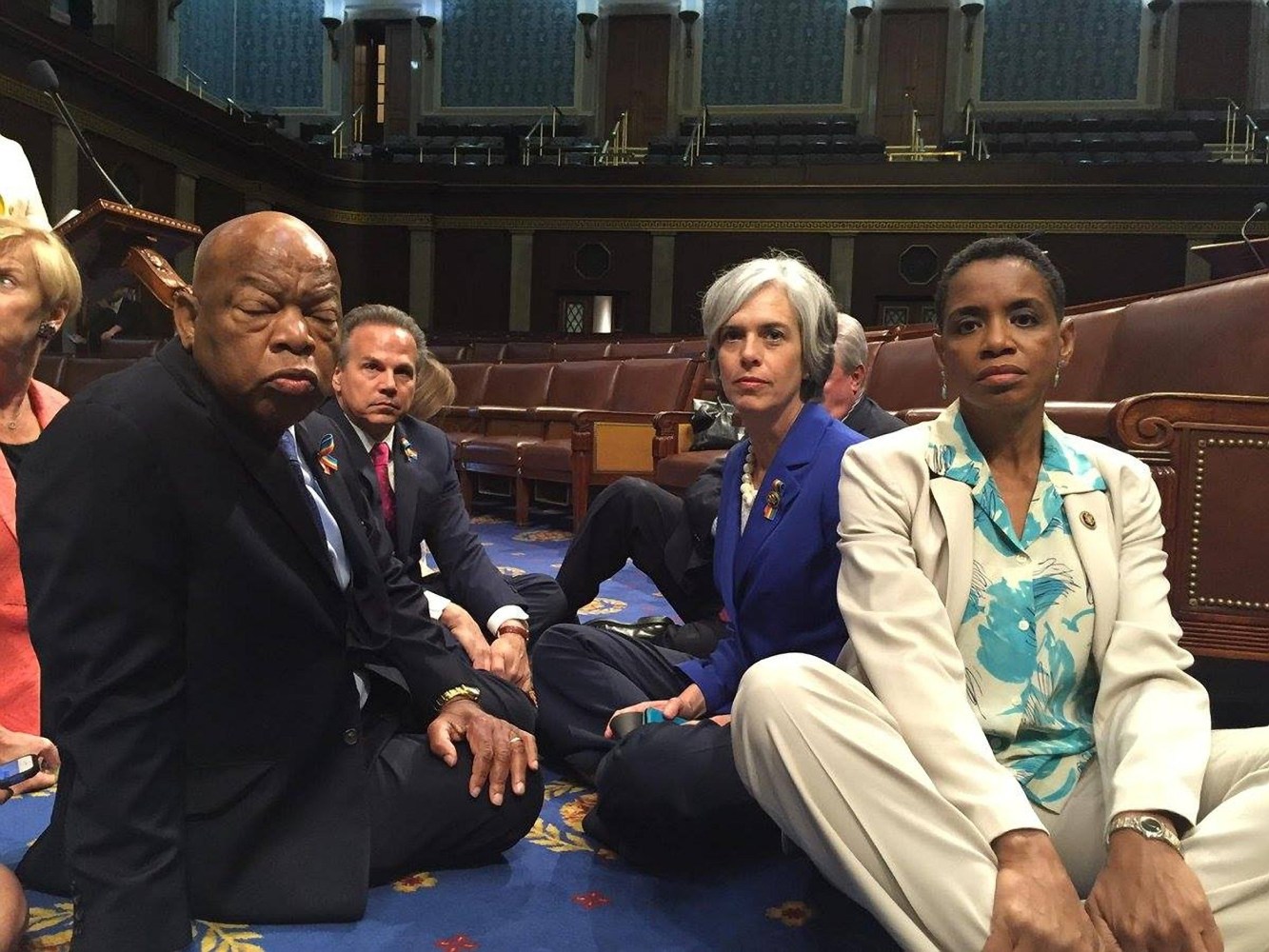
House Republicans have proposed punishing representatives who shoot video or take photos on the floor of the chamber — a change in rules seen as a direct response to a dramatic sit-in in June by House Democrats demanding a vote on gun control legislation that was streamed live online.
The new policy would result in members of Congress being fined up to $2,500 for digital photography, audio or visual recording or broadcasting on the House floor.
"These changes will help ensure that order and decorum are preserved in the House of Representatives so lawmakers can do the people's work," Ashlee Strong, a spokeswoman for House Speaker Paul Ryan, said in a statement Monday.
FROM JUNE 22: House Democrats Stage Revolt, Sit-In at U.S. Capitol Over Gun Control2:37
In June, Democrats led by civil rights icon Rep. John Lewis, D-Ga., staged a dramatic sit-in on the House floor with fellow Democrats to force a vote on gun control legislation.
The protest was not publicly broadcast because the House had not formally gaveled into session. Instead, the protest gained steam after Rep. Scott Peters, D-Calif., used the video streaming app, Periscope, to share footage of the sit-in. C-Span eventually broadcast Peters' video feed.
The newly proposed policy, which would have to be approved by the full House when they return in January, would fine a member $500 for the first offense and $2,500 for any subsequent offenses. The funds would be taken out of the member's net salary.
House Democrats, including civil rights leader and Democratic Georgia Rep. John Lewis, stage a sit-in on the House floor in June to demand gun control legislation.
Republican House Speaker Paul Ryan condemned the Democrats' tactic over the summer, calling it at the time a ploy "to get attention."
A GOP leadership aide said the rule changes are prospective and would only apply to future breaches of decorum.
"Bring.It.On.," California Rep. Eric Swalwell, a Democrat who was a leading figure in the June sit-in, tweeted in response to the new proposal.
"Dear @HouseGOP, you can fine me & @HouseDemocrats all the way into bankruptcy for #gunviolence sit-in, but we will always speak for victims," Swalwell said in another tweet.
The new proposal would also clarify what is considered "disorderly or disruptive," saying it would now include "blocking access to legislative instruments such as microphones and blocking access [sic] the well of the House."
As the Republican Congress prepares to vote on repealing the Affordable Care Act, gutting Social Security benefits for seniors and the disabled, and other measures to please their billionaire donor base, they are apparently deathly afraid of the American public seeing them do it, and even more afraid of allowing the public to see the Democrats' response:
House members could be fined and referred to the Ethics Committee if they break rules governing electronic video and pictures in the House chamber under a new rule proposed by House Republicans more than six months after the Democrats' guerrilla sit-in over gun control.
"Any subsequent offense will be assessed at the higher amount, regardless of whether it is connected to any other offense by time or proximity," part of the proposal reads.
The "fine" would be $500 for the "first offense" of photographing or videotaping, with $2500 for every "subsequent offense," according to the proposed Rule.
In addition, the new Republican rule would ban anyone from seeing organized protests by the opposition, because sit-ins in the House well will be banned as well:
In addition, lawmakers cannot block the well of the House as Democrats did with their sit-in in June, when they called for votes on bills strengthening background checks and barring firearms sales to people on the government's no-fly list. The sit-in, which lasted over 24 hours, unfolded less than two weeks after the massacre at the Pulse nightclub in Orlando.
Republicans were apoplectic when their NRA-sponsored efforts to keep guns in the hands of suspected terrorists and those with criminal backgrounds were called out by House Democrats, who relied on social media and phone cameras to alert the American people to their protests while the House was in recess and its internal cameras were turned off. The protests drew widespread positive media coverage.
House Speaker Paul Ryan's office says that the changes are essential to assure the American public that its representatives are doing the "people's work."
Democrats have responded with exhortations to "bring it on:"
If Donald Trump intends to take his conflict-of-interest troubles seriously, that would be an important step in the right direction. The president-elect, however, appears to be missing the point of his problem.
President-elect Donald Trump announced Saturday that he would dissolve his namesake foundation to avoid any potential conflict of interest during his time as president.
The plan may quickly run into a snag, however.
"The Trump Foundation is still under investigation by this office and cannot legally dissolve until that investigation is complete," New York Attorney General spokesperson Amy Spitalnick said in a statement released Saturday.
In a statement, Trump said he would close his controversial charitable foundation "to avoid even the appearance of any conflict" with his role as president. But when it comes to Trump's conflicts, his foundation was hardly at the top of the list of concerns: it's his for-profit enterprises that are the basis for most of the controversies.
And since Trump can't dissolve an entity while it's still under investigation, even this half-step may not happen.
The president-elect nevertheless seems eager to talk about the end of his scandal-plagued foundation, arguing via Twitter last night that "all" of the money it raised was "given to charity." He added soon after that "100%" of the millions raised went to "wonderful charities."
A month ago, the Trump Foundation admitted in official documents that "it violated a legal prohibition against 'self-dealing,' which bars nonprofit leaders from using their charity's money to help themselves, their businesses or their families." The materials, filed with the IRS, were signed by Trump himself – so it's not as if he can credibly claim he had no idea what was going on.
In other words, when Trump boasted last night that "100%" of the money raised by his foundation went to "wonderful charities," it was one of the president-elect's more obvious lies.
Donald Trump is having a hard enough time finding someone to perform at his inauguration. It appears the roster of acts willing to play an inauguration ball is equally bare.
Going down Thursday, January 19th at the Hyatt Regency, the All American Ball "is a toast to American culture, featuring a stellar list of special guests, plus multiple areas of entertainment and attractions, which represent the diversity, energy and promise of America."
Just who makes up this "stellar list"? Well, they've got Nashville singer-songwriter Beau Davidson, who will be performing music from his latest album, The American Gentleman; The Reagan Years, "one of the HOTTEST '80s cover bands" who only perform music released during Ronald Regan's presidency; and a wedding band called The Mixx; plus DJ sets by DJ Romin, DJ Young Rye, DJ Flow, and — my personal fav — DJ Freedom. The Star Spangled Singers will also take the stage to serenade party-goers with "uplifting, patriotic songs and instrumentals.
President-elect Donald J. Trump has said he would like to create a "tax holiday" so that American companies can bring back profit that was generated overseas at a lower rate. In his view, this influx of cash will create jobs.
But corporate boards and executives may have different ideas.
They are likely to use much of the estimated $2 trillion held overseas to acquire businesses in the United States, to buy back their own stock or to pay down debt, say advisers of America's top corporate executives.
Merger bankers "are sharpening their pencils with what types of deals those larger companies can look at," said Marc-Anthony Hourihan, co-head of mergers and acquisitions in the Americas for the Swiss bank UBS. "I think M.&A. will be fairly high on the list."
American corporations have kept an accumulation of earnings abroad because they would be subject to paying more taxes when they bring it home.
Mr. Trump has said he wants to repatriate such corporate profits with a one-time rate of 10 percent. That is about a third of what is required by the current law, which says companies need to pay up to 35 percent of their earnings to the government, and then get credited for taxes they have already paid overseas, which usually is not much.
If they were to bring that capital back, those companies could use it to invest in their businesses, which may in turn create jobs. Yet that is only one of several options.
If the priority turns out to be deals, that would be good news for investment bankers who generate fees from large advisory assignments. It would be less so for American workers who might get laid off as a result of cost cuts derived from combining two companies.
Job losses did result the last time Congress initiated a tax holiday, in 2004. The top 15 repatriating companies brought home $150 billion but reduced their work force by 20,931 jobs, according to a 2011 study commissioned by the Senate Permanent Subcommittee on Investigations.
Some of those cuts were tied to mergers and acquisitions. As part of the study, Oracle explained how its repatriated funds were used for two acquisitions: Retek, a software provider to the retail industry, and PeopleSoft, a rival in enterprise software. After buying both for a combined $11 billion, Oracle "eliminated thousands of jobs," the study found.
Today, bankers are rearranging their chess boards, trying to figure out which companies may want to make moves, and which ones might be ripe for the taking. That has kept the bankers in technology and health care busy. Some of the top companies on everyone's watch list include Alphabet (Google's parent company), Amgen, Apple, Cisco, General Electric, Hewlett-Packard, Johnson & Johnson, IBM, Microsoft and Oracle.
Yet at the moment, the potential for tax reform in 2017 has led some companies to delay deal making, according to Marc Zenner, the co-head of J.P. Morgan's corporate finance advisory team.
Photo
Lawrence J. Ellision, chief executive of Oracle, at a hearing over his company's takeover bid for PeopleSoft in 2004. Oracle used repatriated funds to buy PeopleSoft and another software provider, and then eliminated thousands of jobs, a congressional study found.Credit Paul Sakuma/Associated Press
"What you've got right now is a fair bit of uncertainty about what the state of the world will be next year with taxes," he said. "If you don't have to do this deal right now, maybe you can wait until next year so you can finance optimally."
Still, some boards appear to believe they may get a better price if they sign a desired deal sooner rather than later. If tax rates decrease, a company's profitability increases, making it a more expensive acquisition target. And, if all of the repatriating companies go after the same targets, that could drive up the price as well.
"What people fear is that if everyone waits for clarity on timing and specific tax treatment, the markets could be a lot higher, purely as it relates to this influx of capital," Peter A. Weinberg, founding partner at Perella Weinberg Partners, said. "Do you commit capital today with the risk of timing, or do you wait for certainty and risk paying more than you would today?"
Mr. Weinberg said that if there were a significant reduction of the tax rate, companies would bring at least $1 trillion back, an amount large enough to affect the prices of equities and debt.
Some companies may not be interested in deal making. Apple, which has the largest overseas cash load, is historically not a big acquirer; its largest purchase was its $3 billion deal for Beats Music and Beats Electronics in 2014. Microsoft, with the second-largest cash hoard, will most likely still be digesting its $26 billion acquisition of LinkedIn, announced in June.
But these companies will not get away with simply letting the cash sit on their balance sheet unused for too long.
"If the money is coming back, it would be hard to tell investors, 'I have access to it and you're not getting it,'" Mr. Zenner said.
A certain class of hedge funds, known as activist investors, have been known to screen for companies with large piles of cash relative to their market valuations. They take large stakes and then push management to use the money for stock buybacks or richer dividends.
During the 2004 tax holiday, stock repurchases were a forbidden use of the cash, but that rule proved difficult to enforce. A 2009 study by the National Bureau of Economic Research found that each dollar of repatriated cash was linked to an increase of 60 to 92 cents in some form of payout to shareholders.
Five years later, Thomas J. Brennan, now a tax professor at Harvard Law School, published a paper debunking those figures, arguing that of every dollar brought home among the top 20 companies, 72 cents were deployed for permissible uses, including 49 cents on acquisitions, 10 cents on debt reduction and 9 cents on research and development.
There are far more activist investors with billions more in capital to deploy this time. While activists' assets under management declined slightly this year, they still amount to about $175 billion, 50 percent higher than just four years ago, according to data compiled by the research firm Activist Insight.